“Smart forestry” as a Community-Based Teacher Professional Learning to Support ESOL Practicesi
La “gestión forestal inteligente” como contenido basado en la comunidad para el aprendizaje profesional docente para apoyar las prácticas de ESOL
A “gestão florestal inteligente” como aprendizagem profissional de professores para apoiar práticas de ESOL
DOI:
https://doi.org/10.18861/cied.2025.16.especial.4031
Cory
Buxton
College of Education, Oregon State University
United
States of
America
cory.buxton@oregonstate.edu
https://orcid.org/0000-0001-7751-3611
Francisca
Marrs Belart
College of Forestry, Oregon State
University
United States of
America
francisca.marrs@oregonstate.edu
https://orcid.org/0000-0002-2348-965X
Diana
Crespo-Camacho
College of Education, Oregon State
University
United States of
America
diana.crespo@oregonstate.edu
https://orcid.org/0000-0001-5645-4616
Received:
12/21/24
Approved:
05/21/25
How
to cite:
Buxton,
C., Marrs Belart, F., & Crespo-Camacho, D. (2025).
“Smart
forestry” as a Community-Based Teacher Professional Learning to
Support ESOL Practices.
Cuadernos
de Investigación Educativa,
16(especial).
https://doi.org/10.18861/cied.2025.16.especial.4031
In this paper, we use forestry education as an example of a place-based and community-based topic to simultaneously teach English language skills, STEM problem solving, and career education in a locally relevant field. Our in-service science teacher professional learning framework uses culturally and linguistically sustaining tools, practices, and model lessons to support teachers working with all students, including those learning English as an additional language. We argue that science teachers must take the initiative to develop key English for Speakers of Other Languages (ESOL) competencies to support their multilingual learners, and that science teaching is well suited to this integration of content-area language instruction. We analyzed weekly teacher logs completed after school-science club meetings, focus group interviews with the teachers, and conducted a mini case study of one club lesson. We found multiple ways in which teachers in our science professional learning project engaged with the topic of forestry to simultaneously teach English language and science content while also strengthening cultural and community connections to science. We conclude that this approach to preparing content-area teachers to see themselves as content-area language teachers is essential for the future of ESOL education.
Keywords: language of science, multilingual learners, ESOL, forestry education, professional learning.
En este artículo, utilizamos la educación forestal como ejemplo de un tema basado en el entorno físico y comunitario para enseñar simultáneamente habilidades en el idioma inglés, resolución de problemas de ciencia, tecnología, ingeniería y matemáticas (STEM, por sus siglas en inglés) y educación profesional en un campo profesional relevante a nivel local. Nuestro marco de formación profesional para docentes de ciencias en servicio utiliza herramientas, prácticas y lecciones modelo que sustentan la cultura y el idioma para apoyar a los docentes que trabajan con todo tipo de estudiantes, incluyendo aquellos que aprenden inglés como idioma adicional. Argumentamos que los docentes de ciencias deben tomar la iniciativa para desarrollar competencias clave en inglés para hablantes de otros idiomas (ESOL) para apoyar a sus estudiantes multilingües, y que la enseñanza de ciencias se adapta bien a esta integración de la enseñanza de idiomas en las áreas de contenido. Analizamos los registros semanales de los docentes, completados después de las reuniones del club de ciencias escolar, entrevistas grupales con los docentes y un miniestudio de un ejemplo de una lección particular en un club. Encontramos múltiples maneras en las que los docentes de nuestro proyecto de formación profesional en ciencias, abordaron el tema de ciencias forestales en maneras que simultáneamente enseñaban inglés y conocimientos científicos. A la vez que fortalecían las conexiones culturales y comunitarias con la ciencia. Concluimos que este enfoque de preparar a los docentes de áreas de contenido para que se consideren docentes de idioma en áreas de contenido es esencial para el futuro de la educación ESOL.
Palabras clave: lenguaje de la ciencia, estudiantes multilingües, ESOL, educación forestal, aprendizaje profesional.
Neste artigo, utilizamos a educação florestal como exemplo de um tópico baseado no ambiente físico e comunitário para ensinar simultaneamente habilidades em inglês, resolução de problemas de ciência, tecnologia, engenharia e matemática (STEM, na sigla em inglês) e educação profissional em uma área de atuação localmente relevante. Nosso marco de formação profissional para professores de ciências em exercício utiliza ferramentas, práticas e lições modelo que integram a cultura e o idioma para apoiar os professores que trabalham com todo tipo de alunos, incluindo aqueles que aprendem inglês como segundo idioma. Argumentamos que os professores de ciências devem tomar a iniciativa de desenvolver competências-chave em inglês para falantes de outras línguas (ESOL) para apoiar seus alunos multilíngues. Além disso, consideramos que o ensino de ciências é adequado para integrar a aprendizagem do idioma nas áreas de conteúdo. Analisamos os registros semanais dos professores, preenchidos após as reuniões do clube de ciências da escola, entrevistas em grupos com os professores e um mini estudo de caso de uma aula particular realizada em um clube. Descobrimos diversas estratégias adotadas pelos professores do nosso projeto de formação profissional em ciências para abordar o tema das ciências florestais de forma integrada, ensinando simultaneamente inglês e conteúdos científicos e, assim, fortalecendo, as conexões culturais e comunitárias com a ciência. Concluímos que preparar professores de áreas específicas para também se reconhecerem como professores de idiomas em suas disciplinas é uma abordagem essencial para o futuro da educação ESOL.
Palavras-chave: linguagem científica, estudantes multilíngues, ESOL, educação florestal, aprendizagem profissional.
In this paper, we use forestry education as an example of a place-based and community-relevant topic for simultaneously teaching English language skills, STEM problem solving, and career education to all students, including multilingual learners. We show how our in-service teacher professional learning model applies theories of culturally and linguistically sustaining pedagogies to practical methods for supporting teachers of multilingual students using tools, practices, and model lessons developed in our project. More specifically, we address the research question: How do teachers in our science professional learning project take up the topic of forestry in ways that simultaneously teach English language development and science knowledge while also strengthening cultural and community connections to science? Alternatively, put another way, do teachers see a place-based topic such as forestry as a useful way to bridge from theoretical pedagogical frameworks to practical teaching methods for content focused language learning? We argue that this approach to preparing content area teachers to see themselves as content area language teachers is essential for the future of English for Speakers of Other Languages (ESOL) education (Buxton et al. 2018).
There are several reasons why content area teachers need to take more ownership of teaching the language of their discipline. First, because the number of specialized ESOL teachers is not keeping pace with the number of multilingual students, all teachers must come to see themselves as language teachers if all students are to receive the language instruction they need (Whiting, 2017). In the United States, where we work, science teachers rarely get direct support from ESOL teachers, since that support primarily goes to language arts and mathematics classrooms, where accountability and assessment measures are likely to focus (Mitchell, 2022). Thus, many multilingual learners continue to receive inequitable learning opportunities in science and other subjects (Grapin et al., 2023). We argue that the lack of robust collaboration and cross training between ESOL teachers and science teachers has been at the root of this issue.
Second, in recent years, there has been a push in ESOL education to do more than just teach English, recognizing that some content is always used to teach language, and that we can do more to ensure that this content is meaningful for the learner (Bauler & Kang, 2020). Much of traditional ESOL education has focused on basic social communication, which, while important, is not aligned with either academic purposes or career-related knowledge and skills. However, many ESOL teachers lack the content-area knowledge needed to teach the specific disciplinary language required to engage in and communicate about disciplinary practices such as science (Tigert & Peercy, 2018). Thus, ESOL specialists cannot do this job alone; they must partner with teachers who have the relevant content area background. Such partnering among teachers with different strengths, interests, and skills also models for students what we know about the value of learning together with others who bring a different perspective to the topic (Fam et al., 2018). Fortunately, science has been shown to be well suited to such transdisciplinary learning, integrating language and science through instructional strategies such as hands-on investigation, multimodal representations, and applied problem-solving (Harman et al., 2020).
While ESOL teachers may lack the depth of disciplinary content and experience to successfully teach a subject such as science, most science teachers are likewise underprepared to explicitly support students in learning the language of their subject (Rutt et al., 2021). This argument can be made for all content areas, but there are reasons why it is particularly important for all students to receive robust and contemporary science education. First, technologies resulting from modern science and engineering play an ever-increasing role in our daily lives (Sima et al., 2020). Second, many of the challenges we currently face as individuals, families, communities, and society (e.g., health care, affordable housing, climate change) have possible solutions that are linked to science and scientific problem-solving (Lee & Grapin, 2022). Third, many of the fastest-growing, living-wage career fields around the world today are in STEM or STEM-adjacent fields (Navy et al., 2021). This includes a wide range of job types that require STEM knowledge and skills but not necessarily a college degree (e.g., wind and solar energy technicians). Thus, all science teachers need to see themselves as having an essential role in teaching the language practices as well as the investigation practices of science to all their students. Our project seeks to support this goal.
To address these needs, both content-area teachers and ESOL teachers need continuing professional learning on how to work more effectively with multilingual learners. While some states in the U.S., such as California and Florida, have mandated ESOL endorsement for all teachers regardless of subject (Gras & Kitson, 2021), this step has not been sufficient, because working successfully with multilingual learners requires more than just using the language supports promoted in traditional ESOL programs. Indeed, equitable teaching must include culturally and community-sustaining pedagogies as well because, without a connection to culture and community, home language support is typically positioned as transitional support, available only until students learn enough English to survive in English-only instruction (Turkan et al., 2014). Further, there is growing evidence that applied science fields are particularly well suited to rethinking ESOL education (e.g., Lee & Grapin, 2024). Thus, we wished to test the idea that the discipline of forestry in Oregon could simultaneously support the teaching of English language communication skills, sustain and deepen home language communication skills, teaching general STEM practices, and developing specific skills within a science discipline that has local and regional career applications.
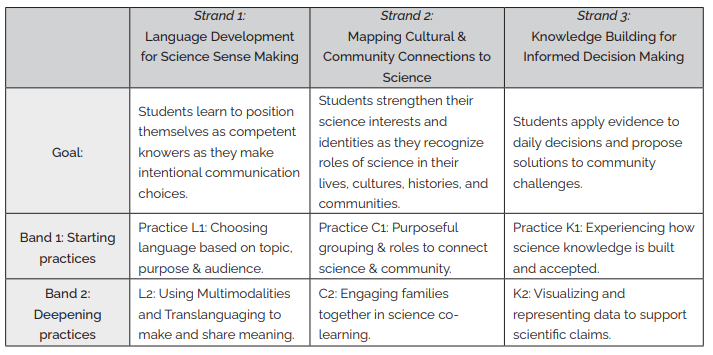
Our Language, Culture, and Knowledge-building through Science (LaCuKnoS) project works primarily with after-school science clubs run by teachers across elementary, middle, and high school contexts. While approximately 25% of these teachers have ESOL endorsements (and 7% have dual-language endorsements), most are science teachers (in middle and high schools) or elementary generalists with little to moderate preparation in ESOL for supporting multilingual learners. Our project provides professional learning to these teachers using a theoretical framework that integrates language development for improving science communication, cultural and community connections to science, and science knowledge building for informed decision-making in our daily lives (see Table 1). We use the specific science discipline of forestry as an example of how to select and teach a science subject with place-based, cultural, and community relevance, as described below.
Table
1
The
LaCuKnoS framework of practices
The amount of precipitation, temperature range, and soil profile in the state of Oregon in the U.S. create a perfect environment for forests to grow and flourish. Thus, timber harvesting has a long history in the region, where logging has been part of the economy and the culture of many local communities since the 1800s. Today, more than 60,000 people in Oregon are employed in the forest sector, and the forests that cover nearly half of Oregon’s land area (OFRI, 2023) are both ecologically diverse and critical to the state’s economy, with Oregon producing more softwood lumber and plywood than any other state in the United States.
Changes in policy, demographics, and wood markets have strongly shaped the forestry industry in Oregon over time, and the field has increasingly modernized in recent years to remain competitive and sustainable while providing the ecological, social, and economic services that are expected from the forest (Kan, 2012). However, one of the main issues currently facing the forestry sector in Oregon is a growing labor shortage. This labor shortage includes jobs that require significant formal education, such as forest engineering, as well as jobs requiring less formal education, such as logging crews (Spinelli et al., 2019).
The 2023 U.S. Census Bureau statistics show that the forestry workforce in Oregon is aging: workers between the ages of 24 and 44 comprised 60% of the forestry workforce in 1992 but shrank to 38% in 2022, the number of workers between 55 and 64 years old has doubled in the same period, and workers older than 65 years old has increased tenfold (from 1% to 10%). While the increased use of automation and technology has helped to offset these worker shortages and improve safety (Axelsson, 1998), new recruitment strategies and training opportunities are needed to motivate potential future workers and to provide them with new STEM skills. This makes forestry in Oregon an ideal example of a place-based and community-relevant topic for simultaneously teaching English language and career-relevant knowledge and skills. To this end, the LaCuKnoS project developed a series of model lessons to teach the next generation of Oregon students about forestry and forestry careers.
Based on both local and global forestry trends, we selected three key topics for our forestry model lessons. The first topic of forest restoration and fire management involves knowledge and skills for understanding and incorporating natural processes, including disturbances such as fires, into active forest planning to increase forest wildfire resilience. The second topic of forest engineering involves analytical skills required for evaluating systems of human-nature interactions, such as integrating the operational and economic aspects of forest management with sustainable practices. Our third topic, wood science and renewable materials, highlights knowledge of wood as a renewable building material that can replace traditional non-renewable building materials. These themes point to advances and innovations that are sometimes referred to as “smart forestry.” Each of these themes can also provide unique and rich examples of how to use forestry to simultaneously teach language, science, and career education in culturally and linguistically sustaining ways. In this paper, we focus specifically on the third theme of wood science and renewable materials to highlight one important current wood science innovation called Cross-laminated timber.
One of the most impactful advances in wood science introduced in the Pacific Northwest in recent years is Cross-laminated timber (CLT), which involves the construction of large-scale, prefabricated, solid engineered wood panels. These panels are built by arranging small pieces of wood laid out perpendicularly to each other in layers to build massive panels. These panels can be designed and assembled as a “puzzle” to build large multi-story buildings or stronger manufactured housing. Over time, buildings made of renewable CLT panels can replace non-renewable building products, such as concrete and steel, which cause more environmental damage.
Innovations like CLT highlight the application of science in community contexts to solve social problems. CLT panels can be made from smaller pieces of wood than conventional lumber, providing a new market for small-diameter trees that have become an increasing fire hazard due to overstocking and the warmer and drier weather that has resulted from climate change. In the U.S., there is a desire to reduce fuel accumulation in national forests to reduce the risk of fires, but harvesting small diameter trees has not been economically worth the cost. CLT construction has created a new and more valuable use for smaller trees, simultaneously reducing fire risks, creating new job opportunities in rural communities, and lowering the cost of housing over time. Thus, community-relevant topics such as CLT provide new educational opportunities for students who may not otherwise see a place for themselves in science, and, perhaps, an increased motivation to learn the language skills required
The LaCuKnoS project uses design-based implementation research (DBIR; Fishman & Penuel, 2018) to engage teachers, students, families, and community members in STEM co-learning through a research-practice partnership. In this partnership, in-service teachers from communities across Oregon lead weekly after-school STEM clubs and annual family engagement events. A university-based outreach and engagement program called SMILE provides the structure and logistics for the partnership, and our research team provides professional learning that prioritizes the enactment of contemporary perspectives on science, language, and culture (Buxton et al., 2024). Together, we explore practices and model lessons (see Table 1) to make science more accessible for all students, particularly multilingual learners and other students from groups that are traditionally underrepresented in STEM educational and career pathways.
Our model builds on the idea that teachers gain confidence in their ability to use new practices and tools by trying them out first in a relatively low-stakes context (Reich, 2022). The after-school science clubs play this role, and teachers are encouraged to subsequently translate our practices, tools, and lessons into their regular science classes, applying these approaches to other lessons they teach. Our professional learning model emphasizes work on both implementing and adapting instructional practices. Rather than expecting all teachers to implement these practices in the same way (with fidelity to an idealized model developed by researchers), we instead expect each teacher to adapt the practices to fit their unique community and classroom contexts, encouraging—and then studying—what we refer to as encouraging and then studying what we refer to as multiplicities of enactment (Buxton et al., 2015).
Human learning and progress have largely occurred through the development and use of tools (physical, conceptual, and communicative) for solving problems. Learning to apply new tools can help us see new possibilities for ourselves. Thus, LaCuKnoS is fundamentally about supporting students in applying and expanding the linguistic, cultural, and knowledge-building tools they possess to make sense of the world and their place in it (Lee & Grapin, 2024). When we discuss tools in the LaCuKnoS project, we are referring to concrete resources that can be helpful for accomplishing science-learning tasks within our integrated model of language, culture, and knowledge building. An example of a language tool is our “language boosters,” which are short, high-interest readings (often including videos and other multimodal resources) that orient students to the topic and provide opportunities for them to talk and think together about what they already know. An example of a cultural tool is the “family conversation cards” that we use to prompt families to talk together about experiences they have had that are relevant to the science topics students are learning. An example of a knowledge-building tool is “scientist stories that explore STEM careers” to help students see themselves as science people.
Practices refer to the specific actions and strategies used to accomplish our goals. A focus on practices has become central to science education in the U.S. since the release of the Framework for K-12 Science Education (National Research Council, 2012), which introduced the idea of science and engineering practices as one of three key dimensions of science learning. In the LaCuKnoS instructional model, we expand this idea to integrate language development practices and culturally sustaining practices as well. An example of a language practice is using multiple modalities to communicate understanding of a science concept. An example of a culturally sustaining practice is using role-play to connect science and community. An example of a knowledge-building practice is visualizing and representing data to support scientific claims. Practices are more general than tools, meaning that these practices can be applied to any lesson or context once a teacher becomes comfortable with them.
Model lessons were developed by the project team to provide practical examples of how to embed our project tools and practices. These lessons were shared with the teachers during workshops held three times a year. The model lessons we developed focus on three themes: 1) societal challenges with local implications, such as health care, climate change, and sustainability issues; 2) how scientists use models to better understand and communicate important concepts; and 3) lessons with a forestry focus to highlight the importance of forestry in our educational context.
Model
Forestry Lessons
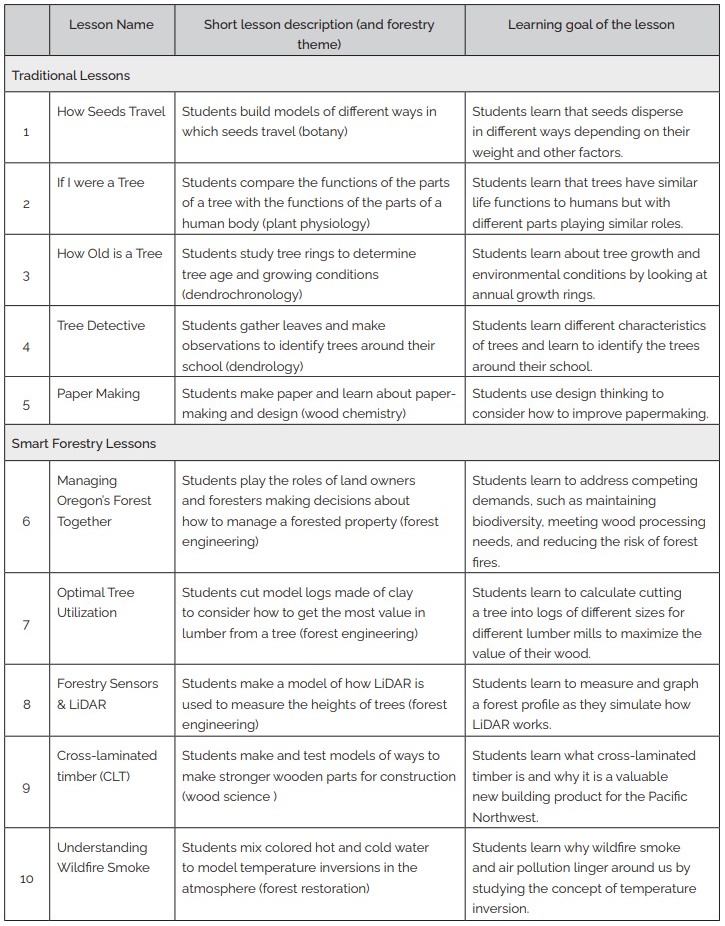
The ten lessons developed with a forestry focus are described in Table 2. We conceived of these lessons as place-based and culturally relevant to the communities in which we work. Five lessons were developed to focus on the three contemporary “smart forestry” topics described earlier: forest restoration and fire management, wood science and renewable materials, and forest engineering. These lessons were new and completely unfamiliar to the teachers. The other five lessons were adaptations of more traditional lessons about trees and forests, updated to integrate the LaCuKnoS tools and practices. Some teachers were familiar with existing versions of these lessons, while others were not. In the findings, we particularly focus on Lesson 9, Cross-laminated timber (CLT), because it was the forestry lesson that the teachers selected and used most frequently in their SMILE clubs.
Table
2
Model
Forestry Lessons
Cross-Laminated
Timber (CLT) Lesson
The main goal of the CLT lesson is for students to understand the potential applications of Cross-laminated timber, as described earlier. More broadly, the lesson teaches about renewable materials and how CLT building materials may help simultaneously lower housing costs and mitigate large-scale forest fires over time. The lesson is divided into three parts. In the first part, students reflect on what they already know about wood and other building materials. They learn about the properties of wood, such as its uneven strength in different directions (anisotropy) defined by the wood grain and how it affects the use of wood as a building material. In the second part, students use small sticks of wood (coffee stirrers or craft sticks) and arrange them in different ways to explore how this changes the strength of the model wooden panels they construct. Students learn that by applying the design of Cross-laminated timber (CLT), in which wood layers are arranged perpendicular to their grain direction, they can create a stronger structure using the same amount of wood. In the final part of the activity, students reflect on how CLT construction might positively affect their lives, for example, by making housing more affordable, reducing the risk of wildfires, and creating new living-wage jobs for workers in Oregon.
Data for this study come from the larger dataset collected in the LaCuKnoS project (Buxton et al., 2024). Specifically, three sources of data describe teachers’ use of our forestry lessons. The first is teacher log data collected over the duration of the project. After each weekly club meeting, teachers completed an online form (teacher log) in which they describe what they did in their club that day, including which LaCuKnoS tools, practices, or lessons (if any) they used. From the database of all teacher logs collected across three academic years (2021-2024), we extracted all references to forestry lessons (N = 114) to explore how these forestry lessons were used at the club level, examining patterns such as differences between elementary and secondary clubs, between regions of the state, and between the “smart forestry” and “traditional forestry” lessons.
The second data source involves teacher focus group interviews conducted at the final teacher professional learning session each year of the project. These focus groups provided teachers with the opportunity to reflect on what they did during the year in their SMILE clubs. Questions were prompted by graphs showing patterns in the teacher log data allowing teachers to reflect more explicitly on the instructional choices they made and the tools and practices they decided to use. All focus group interviews were audio-recorded and then transcribed using automated transcription (TEMI). Transcripts were then reviewed and cleaned by the interviewers. As with the teacher log data, we extracted all excerpts from the teacher focus group transcripts that discussed the use of our forestry lessons (N = 19).
The third data source is a closer look at one club’s use of the CLT lesson. We chose to highlight the CLT lesson because it was the forestry lesson that clubs used more often. The study authors facilitated the CLT lesson in one of the middle school clubs in November 2024. During the lesson, we took pictures, engaged in conversation with the students and collected written reflections from those students who were willing to share (N = 9). These reflections focused on what the students learned from the lesson, why they think forestry will be important in their community now and in the future, and whether they have any interest in pursuing a career in forestry. After the lesson, we interviewed the teacher who runs the club about the lesson itself, the importance of teaching forestry in her school, and her own thoughts about the role of forestry in her community. This interview with the teacher was audio-recorded, transcribed, and cleaned in the same way as the focus group interviews.
Each of the three data sources were analyzed using different methods based on the nature of the data. The teacher log data provided both quantitative frequency counts and qualitative descriptions from the teachers about the lessons used. The qualitative descriptions of how teachers used the lessons in their clubs were coded thematically (Williams & Moser, 2019). Lesson frequencies were analyzed at the club level, at the grade level (elementary, middle, and high school), and by region of the state (Eastern, Western, Southern, and Coastal Oregon), as we hypothesized that each of these distinctions would be relevant to the teachers’ place-based decisions about which lessons to use and how to use them.
Teacher focus group data that mentioned forestry were analyzed qualitatively using project-developed a priori codes for traditional and contemporary practices in teaching language and science (Buxton & Lee, 2023). For example, we distinguish between language practices that seek to replace students’ “everyday” language with “academic” language (traditional) and practices that guide students to see language registers as a continuum (contemporary). Similarly, we distinguish between science practices that prioritize the learning of discrete science concepts (traditional) and those that promote the application of related science concepts to social problems (contemporary).
Data from our teaching of the CLT model lesson consisted of researcher notes from the lesson, the middle school students’ reflection worksheets that they completed, and the teacher interview. These data were also analyzed qualitatively, using open thematic coding as well as our a priori codes for traditional and contemporary practices. In the findings, we present this model lesson through a vignette that synthesizes the key points from our analysis.
This study was conducted in accordance with the ethical standards of the Oregon State University Institutional Review Board (IRB) and was approved on September 1, 2021 (Protocol #IRB-2020-0646). Informed consent was obtained from all individual participants included in the study.
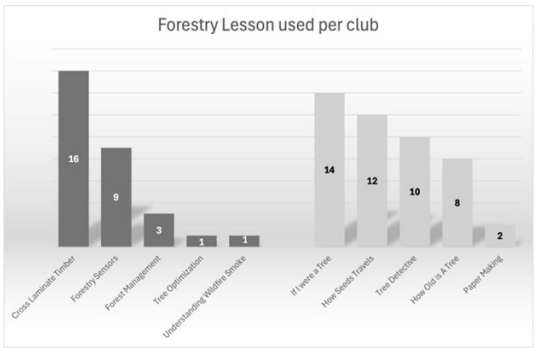
From Fall 2021 to Fall 2024, teachers reported which lessons they used in their clubs. A total of 28 clubs submitted teacher logs during this period. Of the ten forestry lessons we developed (Table 2), 24 clubs reported using one or more of the smart forestry lessons (dark gray), and 22 clubs reported using one or more of the traditional lessons (light gray) (Figure 1). The Cross-laminated timber (CLT) lesson was used most frequently, with sixteen clubs reporting use of the CLT lesson.
Figure
1
Forestry
lessons used per club
When
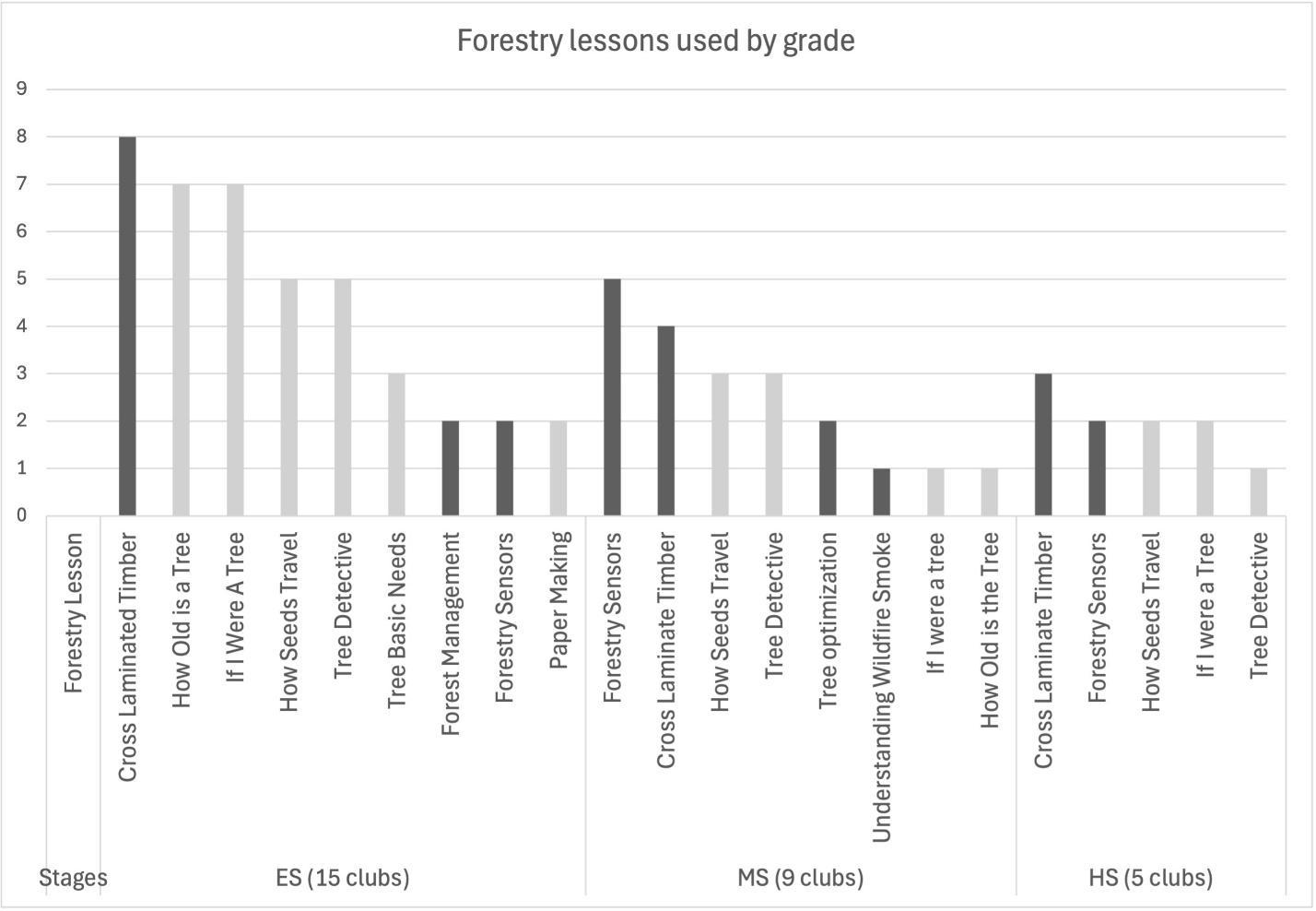
considered across student grade levels (Figure 2), we noted some
areas of consistency (e.g., the average number of forestry lessons
taught remained between two and three per club across the grades) and
some differences (e.g., secondary grade clubs were more likely to
choose the smart forestry lessons while elementary clubs were more
likely to choose the traditional forestry lessons). The fifteen
elementary school (ES) clubs reported using forestry lessons 41
times, with the CLT lesson used most (8 times). The nine middle
school (MS) clubs used forestry lessons 20 times, with the CLT lesson
being the second most used lesson (4 times), and five high school
(HS) clubs used forestry lessons 10 times, with CLT being the most
used (3 times).
Figure
2
Forestry
lessons used by grade
When
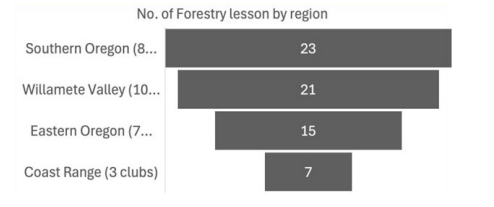
considered across regions of the state (Figure 3), we again observed
similarities and differences. Teachers from the eight clubs in
southern Oregon used the most forestry lessons, twenty-three. This is
not surprising, since Southern Oregon is covered by mixed conifer
forests and has a long tradition of forestry. Thus, we expected the
clubs in this region to be the most engaged with forestry lessons.
Also, the three clubs from the Coast Range, a region covered by
Douglas-fir forests, used the same proportion of lessons as clubs in
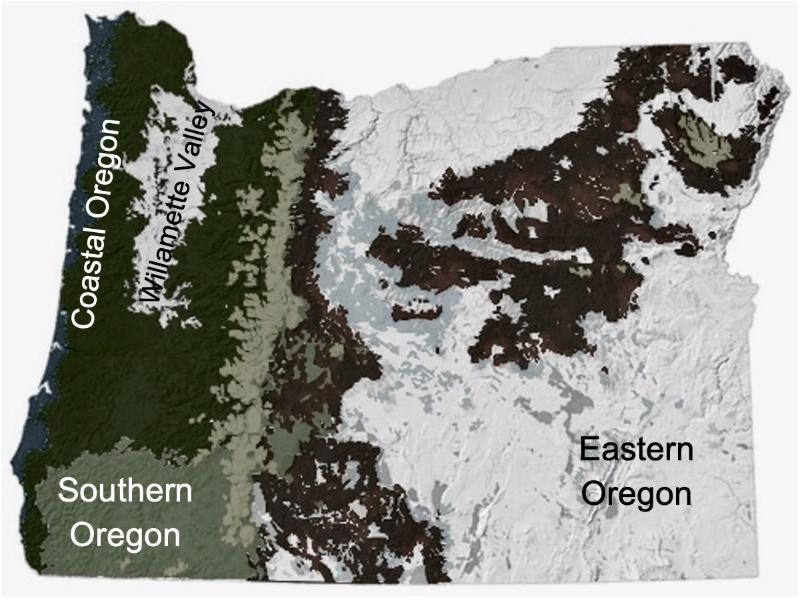
the Southern Oregon region. However, clubs in the Willamette Valley
and Eastern Oregon, regions with significantly less forest land
(Figure 4) and less history of engagement in the forestry industry,
also used a wide variety of these lessons, although less frequently
than the clubs in Southern Oregon and the Coast Range. This indicates
statewide interest, at least on the part of the teachers, in teaching
their students about forestry topics and careers, even in regions of
the state with less forest land.
Figure
3
Forestry
lessons used by region
Figure
4
Oregon
Forest Cover
Note. Adapted from Oregon Forest Resources Institute.
Teachers
also used the logs to share affective information, such as describing
what they appreciated or found challenging about the forestry lessons
they used in their club meetings. For example, an elementary teacher
from the Willamette Valley shared that the CLT lesson “provided
[students] the opportunity to realize that wood can be used in
various ways and how it impacts the building industry and the world.”
Similarly, a teacher from the Coast Range shared:
We live in a heavily forested, rural area where logging is the main source of jobs. Kids are invested because many parents work in the logging industry, and many of our kids enjoy being out in nature and doing nature walks. It is fun to learn more about our native trees. (High school teacher, Coast Range)
These examples highlight how teachers viewed cultural and community connections to science as a rationale for using the forestry lessons.
The teacher focus groups provided teachers with a deeper opportunity to reflect on their use of the LaCuKnoS tools, practices, and lessons compared to the short teacher log forms. We were particularly interested in the connections teachers made between their use of our forestry model lessons and our project practices focused on communication skills, cultural connections to science, and knowledge building around science-related careers. In short, we wondered whether the teachers observed evidence supporting our hypothesis that the forestry lessons would enhance students’ content-area language learning.
More specifically, we hoped that teachers would use our model forestry lessons to support their students in making more strategic language choices rather than feeling pressure to replace students’ everyday language with academic science language. Research has shown that when students feel that they have ownership of their language choices in science, they are better able to construct and communicate scientific meaning in ways that can foster their interests and identities as science learners (Aschbacher et al., 2010). For this to happen, teachers need to facilitate how students solve problems together; as this teacher expressed,
For example, with the Cross-laminated timber, we put them in groups for how to build their designs first and discuss their designs. And they had to agree on a design before they could come up and start asking for their materials. And it was a group effort to learn the details and make sure that everybody understood before you could go on to the next step. But we had a couple kids that wanted to do it on their own and ended up just sitting there until they finally joined a group and started presenting their ideas to the group that they joined. And they took both ideas and put 'em together and were able to expand and they did a fantastic job. (Middle school teacher, Willamette Valley)
This example highlights the collaborative nature of science learning, the importance of planning and designing work using multiple modalities (in this case, drawings and models) before starting an investigation, and the value of students sharing and refining their ideas together. Thus, this teacher emphasized the value of our language practice, using multimodalities and translanguaging to make and share meaning. In contrast, the following teacher focused on applying the LaCuKnoS language development tools, such as language boosters and multilingual concept cards, to help her students develop language practices to support their science sense-making,
The second thing that we did was we started using more visual aids, like the presentations for the forestry stuff so that they can have like an image, the definition, but we kind of just took the information from the language booster and just kind of closed any missing gaps. And then that went with the definitions with the language booster. That was very helpful. (High school teacher, southern Oregon)
While some of the teachers reflected on how our model forestry lessons supported their students in developing new language or using existing language for to deepen their science understanding, other teachers highlighted the cultural and community connections that they saw and heard from students during the forestry lessons. As we argued earlier, a focus on language development that fails to integrate attention to cultural and place-based connections will likely privilege the development of narrow academic English at the expense of both home language development and the broadening of student language registers. In the following quote, a high school teacher highlights place-based connections she made to forestry as well as how, specifically, she adapted the “managing Oregon’s forests together” lesson to better fit her community; a clear example of how we encourage teachers’ adaptations (or multiplicities of enactment) of our lessons,
We did the one for “Managing Oregon’s forests” with our high school students. And we don't have a forest around our area. So, we talked about the agriculture around us, the rotation of whatever they're planting that year. So, it's not always the same in the same field. We talked about crop rotation and we made connections to the BLM [Bureau of Land Management] and how they manage the land, more than anything for the fires, because that's what's really big around our area. A lot of our students, parents, or uncles, or family work for the BLM during the summer. And a lot of them work in agriculture. So yes, a lot of our students may have never been in a forest, but they were able to understand and make the connections of how to take care of what's around you. (High school teacher, Eastern Oregon)
Beyond connecting language and community, we hoped that the teachers would use our forestry lessons to teach broader science practices. Learning to recognize where and how our project practices are embedded in the model lessons is a central focus in our professional learning workshops. We asked teachers to consider how those practices can be applied to any lesson (not just our model lessons), and in the focus groups, we saw evidence that this was starting to occur. One teacher reflected on how he adapted the CLT lesson to highlight additional science practices, such as experiencing how science knowledge is built and accepted, as his club worked together to design tests for the strength of their CLT constructions:
We did the Cross-laminated timbers, and we made it into a challenge and that was most likely the first time any of those students had ever heard about structures being made out of lumber of that size. I mean most of their houses are made out of two by fours and two by sixes but we were able to show them the large magnitude of the abilities of wood and actually having them create a small model and then testing it to see how much weight it can hold and withstand. So I think that was one of those things that’s completely new knowledge for a lot of the kids. Plus, our kids don't see a lot of large trees. (Middle school teacher, Eastern Oregon)
Thus, the focus groups provided the teachers with an opportunity to reflect together on how they used our forestry lessons as a place-based and community-relevant topic in their clubs. Overall, these conversations helped us see the multiple ways in which the LaCuKnoS tools, practices, and model lessons allowed teachers in the project to integrate the teaching of language and content in ways that supported sense-making for all of their students, taking into account the linguistic, cultural, and ecological backgrounds of their communities.
Vignette - How the CLT lesson fostered content area language learning
The middle school was located at the edge of town, in sight of foothills covered in fir trees that extended away into the distant mountains. School was letting out for the day as we arrived and made our way to Ms. Field’s science classroom, where the after-school SMILE club meets. Over the next 10 minutes, students got and ate snacks, chatted together and then got seated and ready for the club meeting. Our team had worked with Ms. Field for the past three years during multiple professional learning workshops and we had participated in several other activities at her school. We knew that Ms. Field had a university degree in forestry and a strong interest in her rural students learning about agriculture, forestry and other applied sciences to engage and motivate them more broadly to see value in their education.
Francisca, a professor of forestry, led the students through the CLT lesson by starting with background information about forestry, concepts of renewable materials, wood grain, wood strength, and an explanation of cross-laminated timber. Using a video, she showed the manufacturing process of a CLT panel with examples of buildings in our state. After that, she presented activity materials to the students and physically demonstrated the process of building a wood panel in which wood is not crossed (arranged in a parallel fashion). After that, she did the same for the process of building a small version of a cross-laminated timber panel using the same amount of materials as the parallel panel. At the end of the lesson, she showed the students finished (dried) panels so they could see and experiment with them, testing their strength and flexibility.
While the students constructed their CLT models, Ms. Field prepared an extension activity that was an adaptation of our model lesson. She added bubble solution to plastic cups and then gave each student a rectangular piece of pine wood and asked if they could use the wood to blow bubbles in the cup. Students were surprised to see that the wood acted like a drinking straw because of the xylem or wood fibers in the wood that carry water up a tree trunk. This clearly demonstrated for the students why wood is normally stronger across the wood grain and weaker along the grain (because of the wood fiber arrangement). Students were asked to use this evidence to explain why cross lamination is an effective technique for making wood stronger.
As we observed the students during the lesson, we were pleased to see how they simultaneously engaged in using science practices, communicated about what they were learning using a range of linguistic and non-linguistic modalities, and made connections between the activity and the needs and resources of their community. One student summarized this well during our reflection activity when she noted, “I learned that wood is stronger when you cross it. Forestry is important in our town because we need wood to build houses, and we also need to protect wildlife.”
After the lesson, as the students packed and headed home, we chatted with Ms. Field about our forestry lessons and what value she saw in them for her students. We were impressed by the connections she made between practices for supporting language development, cultural connections and applied knowledge building, as she considered how she would adapt the lesson specifically for her students. “So if you have pictures of horizontal and vertical and then labels for what we actually call that in the timber industry – isotropic and anisotropic – having the words up there and then if people have heard of abiotic or something to tie it to ISO-metric or iso, with triangles like isosceles. Some of them will have heard those terms. And then, when we talk about the strength of the vertical versus the horizontal, maybe start that part by asking who has split firewood. And I thought about string cheese and that whole cultural experience 'cause they just had string cheese for snack. So is it easier to peel the strings or to break it in half, and it will bend before it breaks?…. And I just happened to have those oak tubes. And that's what I thought about when you were doing the arm motions. The more modeling you can do of stuff, the better and stronger [the learning] is gonna be because they can do both the visual and the auditory.”
Participating in the CLT model lesson with Ms. Fields’ club reinforced and made visible for us the critical importance of holding an integrated view of language, cultural and knowledge practices if we are serious about providing equitable learning experiences for multilingual learners, especially in the secondary grades.
In this study, we asked the question, how do teachers in the LaCuKnoS project use the topic of forestry in ways that teach English language development and applied science knowledge while also strengthening cultural and community connections to science? Through our analysis of teacher log data, teacher focus groups, and direct experiences facilitating this work with teachers and students, we conclude that teachers relied on a combination of their own unique interests and backgrounds, their knowledge of their specific students and communities, and what they learned from the resources we provided, to make intentional pedagogical choices and to adapt these resources to meet their needs. Teachers found that the forestry lessons we developed provided clear and practical examples of how to enact our pedagogical model.
More specifically, to support language development for improved science communication, teachers often relied on our project tools, such as language boosters and concept cards, that reinforced the practice of making strategic communication choices rather than attempting to replace students’ everyday language with the academic language of science. Teachers also reflected on how embedding these tools in the model lessons helped them remember the importance of attending to language as part of the science lessons they taught.
To support cultural and community connections to science, teachers recognized that they can and should modify the examples and activities in our lessons to make them more relevant to their students’ lived experiences. The teacher who shared how she used the example of crop rotations in agriculture to explain forest management to her students clearly shows how this can be done. Elsewhere (Buxton, 2025), we have proposed a model of community-sustaining pedagogies to elevate multiple local voices and perspectives in ways that help students generalize their understandings from the local to the global level. Teachers in the project have begun to reflect this approach in their after-school clubs.
While we see many potential implications for this work, we conclude with just a few that seem to be most important in an increasingly uncertain world. First, for teachers whose primary role is to teach English to speakers of other languages, our research reinforces the well-established idea that English can and should be taught in contextualized ways that simultaneously build relevant content area understanding through the application of new language for the understanding of new content (Turkan et al., 2014). At the same time, disciplinary content can be used to better connect English to cultural and community resources, such as through community relevant topics or home languages (Grapin et al., 2023). While the topic of science, and the more specific sub-topic of forestry, is just one example, we have argued that science is a particularly useful subject to apply in ESOL education due to its everyday relevance and connection to fast-growing career fields. At the same time, we have shown that content-area teachers must be full partners in this work as they learn to integrate content area language teaching into their instruction.
Thus, the clearest implication for content area teachers is that they cannot offload the work of language learning to their ESOL or English language arts colleagues. While a co-teaching model may be ideal, the reality is that most content area teachers will not have an experienced ESOL co-teacher on a regular basis, if ever. Instead, science teachers must take ownership of this piece of their teaching, seeking the help of ESOL specialists when possible while also developing this expertise for themselves over time.
We believe that the primary implication for teacher educators, professional development providers, and educational researchers parallels this implication for teachers. Much like teachers, many teacher educators see themselves as narrow content area experts who may resist, either explicitly or implicitly, the idea that they need to integrate content area language learning strategies into their own work with teachers, rather than leaving this work to a colleague. The LaCuKnoS project-forestry model lessons and the CLT lesson in particular, provide concrete examples of what such integration can look like.
Following our design-based approach to research, we continue to work with teachers to co-design new model lessons and revise our project tools and practices. In the next phase of the work, we also plan to include students as co-designers, working alongside the teachers to deepen the cultural and community connections in our lessons, tools, and practices. Further iterations of our professional learning model can help teachers develop additional place-based and community-relevant topics to bridge from our theoretical pedagogical frameworks to practical teaching methods for content focused language learning.
Notes:
Final
approval of the article:
Lourdes
Cardozo-Gaibisso, PhD, guest editor of the special issue.
Authorship
contribution:
Cory
Buxton: conceptualization, data collection and analysis,
interpretation and writing of the manuscript.
Francisca Marrs
Belart: conceptualization, data collection and analysis,
interpretation and writing of the manuscript.
Diana
Crespo-Camacho: conceptualization, data collection and analysis,
interpretation and writing of the manuscript.
Availability
of data:
Data
from this research is available in an anonymized form upon written
request to the project PI (Buxton) in line with the policies of the
funding agency and our home institution.
Acknowledgments:
We
would like to thank everyone on the SMILE and LaCuKnoS teams and all
the teachers and students who worked with us on this project. This
material is based upon work supported by the U.S. National Science
Foundation under Grant No. DRL-2010633. Any opinions, findings,
and conclusions, or recommendations expressed in this material are
those of the authors and do not necessarily reflect the views of the
National Science Foundation.
Aschbacher, P. R., Li, E., & Roth, E. J. (2010). Is science me? High school students' identities, participation and aspirations in science, engineering, and medicine. Journal of Research in Science Teaching, 47(5), 564-582.
Axelsson, S. Å. (1998). The mechanization of logging operations in Sweden and its effect on occupational safety and health. International Journal of Forest Engineering, 9(2), 25-31.
Bauler, C., & Kang, E. (2020). Elementary ESOL and content teachers’ resilient co-teaching practices: A long-term analysis. International Multilingual Research Journal, 14(4), 338-354.
Buxton, C. (2025). Fostering community sustaining pedagogies through STEAM education. In M. Eisenhart (Ed.), Research Handbook on the Anthropology of Education: Practices and Methods. Elgar.
Buxton, C. Allexsaht-Snider, M., Kayumova, S., Aghasaleh, R., Choi, Y., & Cohen, A. (2015). Teacher agency and professional learning: Rethinking fidelity of implementation as multiplicities of enactment. Journal of Research in Science Teaching, 52(4), 489-502.
Buxton, C., Cardozo Gaibisso, L., Xia, Y., & Li, J. (2018). How perspectives from linguistically diverse classrooms can help all students unlock the language of science. In L. Bryan & K. Tobin (Eds.), 13 Questions: Reframing Education's Conversation: Science (pp. 273-291). Peter Lang.
Buxton, C., & Lee, O. (2023). Multilingual learners in science education. In N. Lederman, J. Lederman, & D. Zeidler (Eds.), Handbook of Research on Science Education (Vol. 3, pp. 291-324). Routledge.
Buxton, C., Well, J., Hale, K., Crespo Camacho, D., Ettenauer, B., Dake, F., Jones, C., & Livingston, M. (2024). Co-designing a justice-centered STEM teacher professional learning project. In L. Evans, K. Allen & C. Turner (Eds), Advancing Critical Praxis and Pedagogy Across Educational Settings (pp. 103-129. Brill.
Fam, D., Neuhauser, L., & Gibbs, P. (2018). Transdisciplinary theory, practice and education: The art of collaborative research and collective learning. Springer.
Fishman, B., & Penuel, W. (2018). Design-based implementation research. In F. Fischer, C. E. Hmelo-Silver, S. R. Goldman & P. Reimann (Eds.), International Handbook of the Learning Sciences (pp. 393-400). Routledge.
Grapin, S. E., Pierson, A., González‐Howard, M., Ryu, M., Fine, C., & Vogel, S. (2023). Science education with multilingual learners: Equity as access and equity as transformation. Science Education, 107(4), 999-1032.
Gras, C., & Kitson, C. (2021). ESL teacher certification policy: Current trends and best practices. Frontiers in Education, 6, 1-6.
Harman, R., Buxton, C., Cardozo-Gaibisso, L., Jiang, L., & Bui, K. (2020). Culturally sustaining systemic functional linguistics praxis in science classrooms. Language and Education, 35(2), 106-122.
Kan, J. (2012). Observations on and implications of the decline in forestry undergraduate enrolment in Canada [Undergraduate Thesis, University of British Columbia].
Lee, O., & Grapin, S. (2024). Justice‐centered STEM education with multilingual learners to address societal challenges: A conceptual framework. Journal of Research in Science Teaching, 34(5), 522-543.
Lee, O., & Grapin, S. E. (2022). The role of phenomena and problems in science and STEM education: Traditional, contemporary, and future approaches. Journal of Research in Science Teaching, 59(7), 1301–1309.
Mitchell, T. (2022). Understanding how ESOL programmes operate to support English language learners in New Zealand secondary schools [Unpublished doctoral dissertation].
National Research Council. (2012). A framework for K-12 science education: Practices, crosscutting concepts, and core ideas. National Academy of Sciences.
Navy, S., Heisler, J., Papa, J., & Gjurkovitsch, A. (2021). Conceptualizing careers: Is there an element of STEM in every profession? School Science and Mathematics, 121(7), 422-433.
Oregon Forest Resources Institute. (2023). Oregon Forest Facts: 2023-24 Edition.
Reich, J. (2022). Teaching drills: Advancing practice-based teacher education through short, low-stakes, high-frequency practice. Journal of Technology and Teacher Education, 30(2), 217-228.
Rutt, A., Mumba, F., & Kibler, A. (2021). Preparing preservice teachers to teach science to English learners: A review. Journal of Research in Science Teaching, 58(5), 625-660.
Sima, V., Gheorghe, I. G., Subić, J., & Nancu, D. (2020). Influences of the industry 4.0 revolution on human capital development and consumer behavior: A systematic review. Sustainability, 12(10), 4035.
Spinelli, R., Visser, R., & Han, H. S. (2019). A decade of forest engineering: Achievements and future directions. Forests, 10(9), Article 724. https://doi.org/10.3390/f10090724
Tigert, J. M., & Peercy, M. M. (2018). Preparing to teach both content and language: Four ESOL teacher candidates' experiences. TESOL Journal, 9(3), 542-556.
Turkan, S., De Oliveira, L. C., Lee, O., & Phelps, G. (2014). Proposing a knowledge base for teaching academic content to English language learners: Disciplinary linguistic knowledge. Teachers College Record, 116(3), 1-30.
Whiting, J. (2017). Caught between the push and the pull: ELL teachers’ perceptions of mainstreaming and ESOL classroom teaching. NABE Journal of Research and Practice, 8(1), 9-27.
Williams, M., & Moser, T. (2019). The art of coding and thematic exploration in qualitative research. International Management Review, 15(1), 45-55.
i The LaCuKnoS project is supported by the U.S. National Science Foundation under Grant DRL-2010633. Any opinions, findings, and conclusions or recommendations expressed in this material are those of the authors and do not necessarily reflect the views of the National Science Foundation.