The ENABLE Model in Argentinian Initial Language Teacher Education: Developing Teacher Identity
Modelo ENABLE en la formación docente inicial argentina: identidad profesional en desarrollo
Modelo ENABLE na formação docente inicial na Argentina: desenvolvimento da identidade profissional
DOI:
https://doi.org/10.18861/cied.2026.17.1.4220
Ana
Cecilia Cad
Universidad Nacional de
Córdoba
Argentina
anaceciliacad@unc.edu.ar
https://orcid.org/0000-0002-2894-5060
Sonia
Vanesa Cladera
Universidad Autónoma de Entre
Ríos
Argentina
cladera.sonia@uader.edu.ar
https://orcid.org/0009-0003-7641-2474
María
de los Angeles Bortagaray
Universidad Autónoma de Entre
Ríos
Argentina
bortagaray.angeles@uader.edu.ar
https://orcid.org/0009-0002-3772-9092
Received:
08/06/25
Approved: 10/29/25
How
to cite:
Cad, A. C., Cladera, S. V., & Bortagaray, M. A.
(2025). The ENABLE Model in Argentinian Initial Language Teacher
Education: Developing Teacher Identity. Cuadernos
de Investigación Educativa,
17(1).
https://doi.org/10.18861/cied.2026.17.1.4220
This exploratory qualitative study analyzes the implementation of the ENABLE model (Díaz Maggioli, 2022) in two different four-year Initial English Language Teacher Education (IELTE) programs in Argentina. The research aimed to examine how the ENABLE model supported student teachers' professional identity development, focusing on its strengths and constraints within two distinct Argentine IELTE contexts. Conducted in two higher education institutions across different provinces, the study involved initial surveys, classroom observations, analysis of lesson plans and coursework, and final reflective pieces. The researchers, who also acted as practicum supervisors in both contexts, adopted a teacher educator–researcher stance to design, implement, observe, and critically examine the pedagogical process and its outcomes. Results show that student teachers (StTs) developed their professional identity to varying degrees through a process in which mentor guidance, reflective practices, and the contextualized application of core concepts and practices played key roles. Relationships with peers, educators, and students, along with institutional contexts, were also influential. The ENABLE model, by organizing situated learning sequences, provided opportunities for bridging theory and practice, enhancing agency, and building professional confidence. Findings point to the importance of supporting student teachers beyond classroom management and lesson planning by integrating sociopolitical, ideological, and cultural dimensions into teacher education. The study contributes to the literature on professional identity formation and calls for the design of teacher education curricula that foster both pedagogical competence and deeper professional awareness.
Keywords: initial teacher education, ENABLE model, sociocultural theory, professional identity, core concepts and practices.
Este estudio cualitativo de carácter exploratorio analiza la implementación del modelo ENABLE (Díaz Maggioli, 2022) en dos programas de formación docente inicial en inglés de cuatro años de duración en Argentina. El objetivo de la investigación fue examinar cómo dicho modelo apoyó el desarrollo de la identidad profesional de los futuros docentes, con especial atención a sus fortalezas y limitaciones en dos contextos argentinos diferenciados. El estudio se llevó a cabo en dos instituciones de educación superior ubicadas en distintas provincias y combinó encuestas iniciales, observaciones de clase, análisis de planes de clase y trabajos académicos, así como producciones reflexivas finales. Las investigadoras, quienes también se desempeñaron como supervisoras de la práctica en ambos casos, adoptaron un enfoque de formadoras-investigadoras para diseñar, implementar, observar y analizar críticamente el proceso pedagógico y sus resultados. Los hallazgos muestran que los futuros docentes desarrollaron su identidad profesional en distintos grados mediante un proceso en el que la guía de mentores, las prácticas reflexivas y la aplicación contextualizada de conceptos y prácticas fundamentales desempeñaron un papel clave. Las relaciones con colegas, formadores y estudiantes, junto con los contextos institucionales, también resultaron influyentes. Al organizar secuencias de aprendizaje situadas, el modelo ENABLE ofreció oportunidades para articular teoría y práctica, potenciar la agencia y fortalecer la confianza profesional. El estudio destaca la importancia de acompañar a los futuros docentes más allá de la planificación y la gestión del aula, integrando dimensiones sociopolíticas, ideológicas y culturales en la formación docente.
Palabras clave: formación docente inicial, modelo ENABLE, teoría sociocultural, identidad profesional, conceptos y prácticas fundamentales.
Este estudo qualitativo de natureza exploratória analisa a implementação do modelo ENABLE (Díaz Maggioli, 2022) em dois programas de formação inicial de professores de inglês, com duração de quatro anos, na Argentina. A pesquisa teve como objetivo examinar como o modelo ENABLE apoiou o desenvolvimento da identidade profissional de futuros docentes, com foco em seus pontos fortes e limitações em dois contextos argentinos distintos. O estudo foi realizado em duas instituições de ensino superior localizadas em diferentes províncias e envolveu a aplicação de questionários iniciais, observações em sala de aula, análise de planos de aula e trabalhos acadêmicos, além de produções reflexivas finais. As pesquisadoras, que também atuaram como supervisoras da prática em ambos os contextos, adotaram uma postura de formadoras-pesquisadoras para planejar, implementar, observar e analisar criticamente o processo pedagógico e seus resultados. Os resultados indicam que os futuros professores desenvolveram sua identidade profissional em diferentes graus, por meio de um processo no qual a orientação de mentores, as práticas reflexivas e a aplicação contextualizada de conceitos e práticas centrais desempenharam papéis fundamentais. As interações com colegas, formadores e alunos, bem como os contextos institucionais, também influenciaram significativamente. Ao organizar sequências de aprendizagem situadas, o modelo ENABLE ofereceu oportunidades para conectar teoria e prática, promover a agência e fortalecer a confiança profissional. Os achados destacam a importância de apoiar os futuros docentes para além da gestão da sala de aula e do planejamento didático, integrando dimensões sociopolíticas, ideológicas e culturais à formação docente.
Palavras-chave: formação inicial de professores, modelo ENABLE, teoria sociocultural, identidade profissional, conceitos e práticas centrais.
Researching teacher identity construction is crucial, as it shapes educators’ professional decisions and long-term engagement. Strong teacher identity is associated with effectiveness (Sammons et al., 2007), informed decision-making (Beijaard et al., 2004), the development of an educational philosophy (Cuadra-Martínez et al., 2023; Mockler, 2011), and professional retention (Hanna et al., 2020). Given the influence of Initial English Language Teacher Education (IELTE) on identity formation, exploring methods that support student teachers (StTs) in developing their professional voice is essential.
While most research on teacher identity construction focuses on Global North contexts, there is a growing need to investigate this process in Latin American settings, where sociocultural, institutional, and political factors shape teacher education in unique ways (Cuadra-Martínez et al., 2023). Despite increasing interest in professional identity formation, little empirical evidence addresses how specific pedagogical models contribute to this process in IELTE programs.
This study addresses this gap by implementing the ENABLE model (Díaz Maggioli, 2022), a situated, socioculturally grounded framework that organizes StTs' learning through a cyclical approach emphasizing observation, reflection, guided practice, and contextual responsiveness. Although the model has gained theoretical recognition, empirical studies remain scarce. This research constitutes the first attempt to apply the ENABLE model in IELTE programs in Argentina.
The aim of this study was to explore the strengths and constraints of the model in supporting StTs’ professional identity development in two IELTE programs, guided by the research question: What opportunities does the model provide for identity construction during methodology and practicum courses? By analyzing two contrasting contexts, this study contributes to teacher education literature and offers empirical evidence to inform the design of teacher education curricula that integrate pedagogical and sociocultural dimensions of professional learning.
Student
Teachers’ Identity
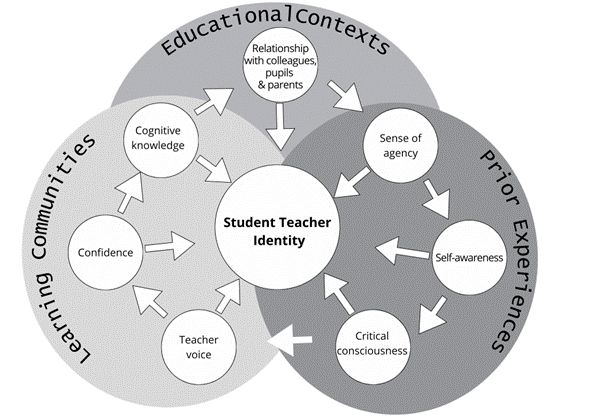
In this study, the definition of StTs’ identity provided by Izadinia (2013) served as the foundation for understanding and interpreting the progression of StTs' identity development. According to this author, StTs’ identity encompasses future teachers' perceptions of their cognitive knowledge, sense of agency, self-awareness, voice, confidence, and relationships with colleagues, pupils, and parents. This multifaceted identity is influenced by their educational contexts, prior experiences, and learning communities (see Figure 1). This definition aligns with the ENABLE framework, which views identity as shaped by socially situated factors.
Figure
1
Student
teachers’ identity (Izadinia, 2013)
Teacher
identity is a dynamic construct shaped and reshaped through the
ongoing process of learning to teach (Trent, 2010). Teacher education
programs play an important role in this process, as they mark the
initial and crucial stage in the development of StTs' professional
identity (Huu & Ngoc, 2017). Studies have indicated that as
students assume professional roles and responsibilities in authentic
educational settings, they make strides in developing their
professional identity (Beauchamp & Thomas, 2009). Consequently,
gaining a deeper understanding of the intricate process of identity
formation among StTs can greatly influence the design and
implementation of effective teacher education programs (Beauchamp &
Thomas, 2009). Thus, exploring this topic can have a significant
impact on teacher education.
Given the centrality of teacher identity, it is essential to examine its development in StTs. Professional identity (PI) in initial teacher education is shaped by professional knowledge, reflective practices (Beijaard, 2019), collaborative learning, and the integration of theory and practice. Academics and schoolteachers serve as role models, with schoolteachers also guiding the practical aspects of the profession (Nguyen & Loughland, 2018). As Bullough (1997) notes, teacher identity underpins meaning-making and decision-making in teaching. The practicum provides crucial hands-on experience, supporting identity formation through practical engagement (Cobb, 2020). Exploring StTs’ PI illuminates the experiences, challenges, and mentoring relationships that influence identity development within contextual, relational, and pedagogical frameworks.
Theoretical
Foundations of the ENABLE Model
Teacher identity is shaped by the approach or model used to instruct StTs (Cuadra-Martínez et al., 2023). The sociocultural perspective of teacher education recognizes teachers as transformative intellectuals who can not only “challenge common school practice” (Cochran-Smith & Lytle, 2015, p. 99) but also create pedagogically effective learning opportunities tailored to specific contexts. This approach promotes teacher cognition through self-exploration, reflective thinking, and critical analysis of teaching practices. StTs play an active role in their own learning, gaining a deep understanding of diverse teaching contexts and adapting their strategies accordingly.
Teacher learning, viewed from a sociocultural perspective, occurs through situated social and individual processes. Novice teachers engage in teaching-oriented communities of practice, using mediational tools to connect theory and practice (core concepts and core practices) with their own teaching. This approach fosters reflection in, on, and for action (Korthagen & Vasalos, 2005) and supports continuous teacher development. Central to this process is principled-mediated interaction, which adapts to different learning styles, paces, and contexts. Mediators, such as teacher educators, support this by providing targeted materials and guidance. The ENABLE model—comprising stages of learning to see, learning to do, and learning to become—addresses StTs' cognitive and affective needs while supporting their knowledge development.
Activities within the framework should be responsive to StTs' developmental stages rather than follow a strict structure. Categorized by purpose, they offer flexible mediational tools that support individual learning needs through organic mediation involving both educators and peers. Effective learning requires situational activities aligned with StTs' prior knowledge, goals, and teaching contexts, enabling meaningful experiences that build core competencies for future classroom practice.
Overview
of the ENABLE Model
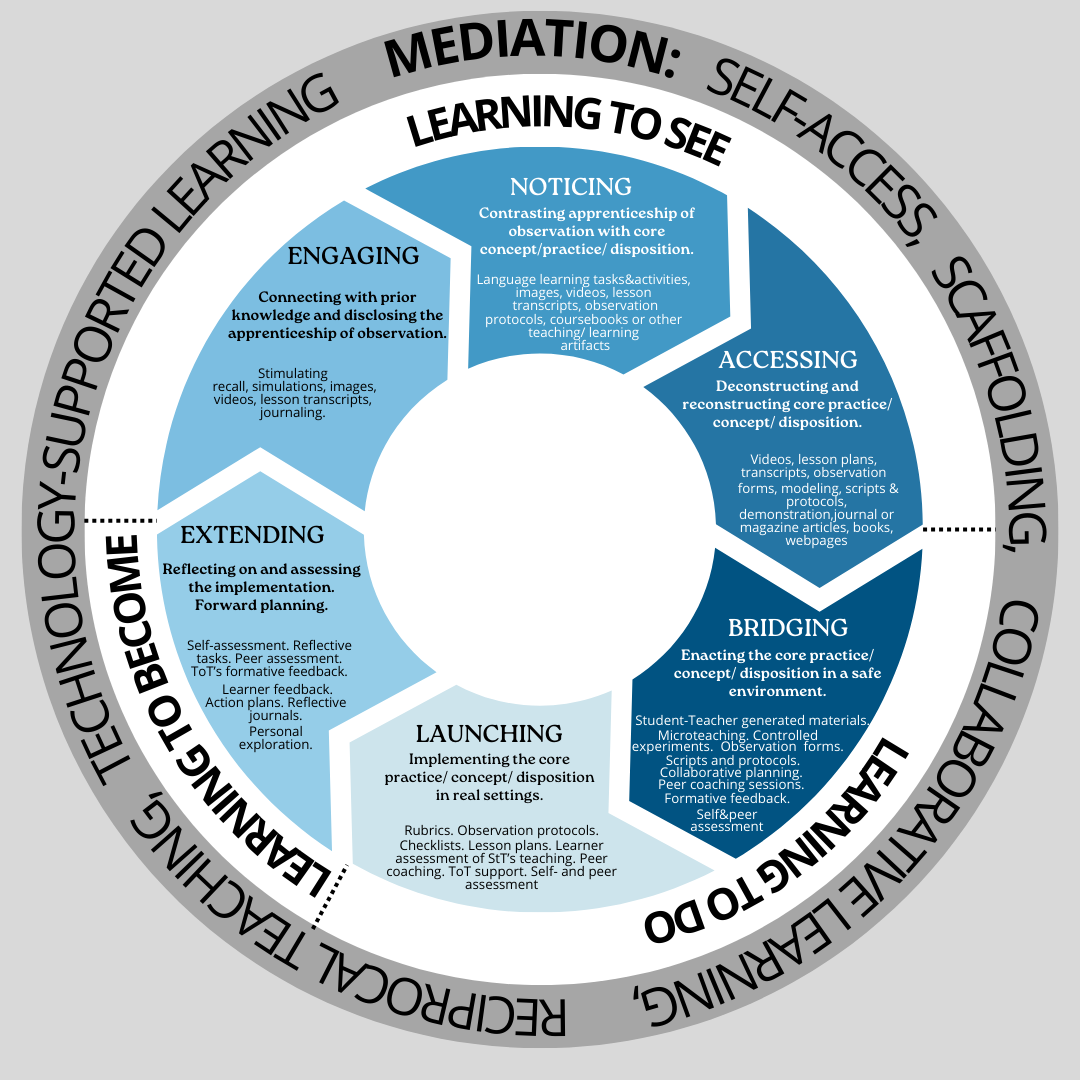
The ENABLE model (Díaz Maggioli, 2022) provides a framework for mediating StTs' learning through three key dimensions: learning to see, learning to do, and learning to become. Rather than following a rigid sequence, its six phases can be adapted to meet learners’ needs (see Figure 2):
a) Engaging: StTs explore core concepts or practices by reflecting on observed lessons, engaging with professional literature, and interviewing relevant individuals. As Grossman (2018) explains, core practices include fundamental teaching tasks (e.g., planning, facilitating discussions, assessing learning), while core concepts refer to the pedagogical and theoretical knowledge that underpins those practices.
b) Noticing: StTs deconstruct and analyze the core concepts or practices, preparing to apply them.
c) Accessing: StTs explore representations of the core concepts or practices through literature, videos, observation tasks, and learning materials, linking theory to practice.
d) Bridging: StTs apply their emerging understanding through activities like microteaching, collaborative planning, and coaching, bridging the gap between theory and practice.
e) Launching: StTs implement the core concepts or practices in the classroom, with peers and mentors providing assessment and support.
f) Extending: StTs engage in planning, self- and peer-assessment, reflection, and goal setting to deepen learning and refine future practice, extending the application of core concepts or practices.
Figure
2
The
ENABLE model (adapted from Diaz Maggioli, 2022)
The
ENABLE model acknowledges the diverse contexts of initial teacher
education and addresses potential challenges. It promotes the balance
between theory and practice, adapts the mediation process to
different programme durations, and supports StTs in developing core
practices, core concepts, and their professional identity. Grounded
in research, it offers a flexible approach to enriching teacher
education.
This qualitative study was conducted in two higher education institutions offering four-year IELTE programmes in Argentina. The research adopted an exploratory and interpretative approach, with the researchers acting as teacher educators and practicum supervisors in both contexts. In line with Corbin and Strauss (2025), the study employed qualitative techniques to explore the opportunities, strengths, and constraints of the ENABLE model in supporting student teachers' professional development during methodology and practicum courses.
Research
Contexts and Participant
The study took place in two distinct IELTE contexts:
The first context was the English programme at a public university in Entre Ríos (UER). Fifteen participants (12 female and 3 male) were enrolled in a programme comprising 36 courses, 8 of which focused on pedagogy and practice.
The second context was a tertiary institution in Córdoba capital (CTI). The seven participants, all female, were in their third year of a programme consisting of 32 courses, including 10 on pedagogy and practice. Their practicum was conducted in a private primary school setting.
In both contexts, the practicum followed a co-teaching model involving observation, lesson planning, peer feedback, guided and independent teaching, and reflective practice. StTs engaged in teaching sequences based on the ENABLE model, which served as the organizing framework for both the methodology course and the practicum.
Data
Collection Instruments and Techniques
Multiple qualitative instruments were employed to collect data across different moments of the practicum, consistent with Creswell and Poth’s (2017) recommendations for methodological triangulation in educational research:
An initial questionnaire was administered to gather demographic data, teaching experience, prior pedagogical knowledge, beliefs, and attitudes towards peer and mentor mediation. This helped assess how StTs' backgrounds could shape their identity development.
Classroom observations were carried out using field notes to document StTs’ engagement with the ENABLE sequence, their classroom decision-making, and their use of core concepts and practices.
Document analysis focused on lesson plans and coursework, particularly those integrating the ENABLE framework.
Final written reflections, submitted through the virtual classroom platform, allowed StTs to analyze their own development and trace their identity construction process.
A post-practicum semi-structured interview deepened understanding of professional learning trajectories.
To meet ethical requirements, participants provided informed consent, and all data were anonymized using alphanumeric codes (e.g., UER5, CTI2).
Research
Procedure
The ENABLE model (Díaz Maggioli, 2022) was introduced at the start of the methodology course in both institutions. Throughout the year, StTs worked through its six recursive phases. These sequences were implemented differently in each context based on local constraints and students’ developmental needs.
StTs participated in class activities designed to help them link theory and practice, reflect on their teaching philosophy, and take increasing responsibility for planning and delivering instruction. The sequences included the analysis of core practices (Grossman, 2018), the use of observation rubrics, and reflection protocols.
The implementation of the model was accompanied by constant mentor mediation, peer collaboration, and opportunities for feedback and self-assessment, in line with Izadinia’s (2016) findings on identity development through mentoring.
Data
Analysis
The data analysis process followed a constant comparative method (Corbin & Strauss, 2015), involving iterative cycles of coding and theme refinement. The main stages guided the analysis:
- Descriptive statistics were generated from the closed responses in the initial questionnaire using Google Forms.
- Inductive and deductive coding of open-ended responses, coursework, and final reflections was conducted based on the initial categories drawn from the ENABLE framework and identity literature (Izadinia, 2013; Beauchamp & Thomas, 2009).
- Triangulation of data sources was employed to enhance credibility (Creswell & Poth, 2017). Data from interviews, observations, reflections, and documents were cross-checked to identify converging patterns related to the evolution of professional identity.
Throughout the process, memo writing was used to document analytic decisions, identify emerging insights, and ensure transparency. The coding scheme was refined through multiple rounds of collaborative discussions among the authors.
This methodological design allowed us to explore not only what StTs did, but also how they understood, reflected on, and articulated their identity development through the ENABLE model.
The findings are organized into three sections, reflecting the progression of the StTs' experiences with the ENABLE model throughout the academic year: 1) entering the practicum and initial perceptions, 2) implementation of the ENABLE model and use of core practices and concepts, and 3) final reflections on professional practice identity development.
Beginning
the School Year
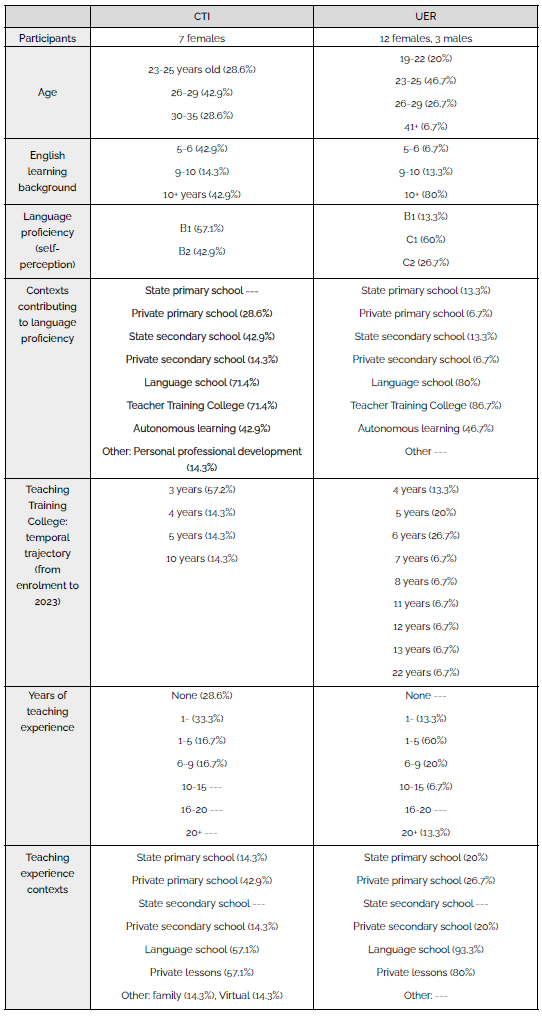
The initial questionnaire explored StTs' language proficiency, prior teaching experience, and beliefs about teaching, contextualizing their initial professional identity and informing the design of the ENABLE sequences. Table 1 summarizes key factors influencing StTs’ professional identity.
Table
1
Results
from initial questionnaire: comparative analysis
StTs'
language proficiency was sufficient for understanding theory,
engaging in discussions, and designing classes according to the
ENABLE model. However, some CTI participants believed they had lower
proficiency in the language, which could potentially affect their
performance, sense of security, and self-esteem.
StTs’ educational backgrounds were diverse, including language schools as well as private and state institutions at both primary and secondary levels. This diversity influenced their beliefs and identity development. Some associated public education with disadvantaged students, limited language proficiency, and scarce resources, while schools in upper-middle-class areas were linked to greater access, higher proficiency, and stronger academic expectations. These perceptions shaped how StTs viewed themselves, their roles, and their students. In less privileged contexts, some believed they should lower expectations, avoid technology-mediated tasks, and use students’ mother tongue, assuming English would be harder to understand.
Teaching experience, mainly in language schools, provided valuable practical exposure for professional identity development. Most StTs had 1–5 years of experience. Their reflections emphasized key aspects such as lesson planning, highlighting its pivotal role in effective teaching and in gaining a deeper understanding of the educational process, as illustrated in the following comment:
The three most important concepts […] were planning and decision-making, variation of the voice and student and teacher talking time. I consider them to be significant in my learning planning process because there were crucial moments in which they play an important role, for instance, which activity to include or which ones not to, how to deal with timing in the class and thus decision making. (UER12)
The application of diverse teaching techniques and strategies was a recurring theme that emerged from the questionnaire, showcasing a versatile and engaging instructional skill set.
StTs also acknowledged personal strengths and weaknesses, demonstrating a commitment to reflective teaching and continual improvement. The fact that StTs had some prior teaching experience had at least two interesting outcomes. On the one hand, StTs had a strong motivation to learn classroom management techniques, since most of them struggled with that. On the other hand, they realized they could teach a class regardless of their content-specific knowledge related to second language pedagogy and methodology. Thus, acquiring metalanguage for key concepts and bridging the gap between theory and practice were cited less frequently, suggesting that they were keener to learn about skills that are more practical.
When asked about the knowledge acquired in other subjects prior to their teacher education course, StTs referred to several areas. They mentioned understanding teaching and learning processes, using didactic strategies and resources, considering contextual factors, and recognizing the impact of social and historical influences on teaching.
However, few mentioned awareness of sociopolitical factors, curricular issues, institutional organization, and education policies. Their lack of awareness of sociopolitical, educational, and institutional issues had an impact on the process of identity building, as content knowledge and classroom management skills were prioritized in preparation for teaching residencies. There was no explicit mention of educational philosophies or related issues that may shape their identity more in line with national issues.
StTs highlighted a range of skills and knowledge essential for professional development. Some emphasized pedagogical knowledge, including approaches, methodologies, content, and subject integration. Others focused on practical aspects such as classroom management, adaptability, flexibility, collaboration, and communication. One student summarized:
The essential skills and knowledge to be acquired during the StTs teaching program are communication […] leadership skills, since the teacher must manage the group of students and carry out the class with the help of content management, planning and different types of teaching methods that adapt to the different conditions and abilities of each student. Communication, emotional and cognitive skills […] A teacher should be dynamic, enthusiastic and fun. (CTI 4)
Reflective teaching, critical thinking, self-awareness, and the integration of theory and practice were recognized as important for developing a professional identity. Inclusion, diversity, and addressing student needs were other areas of focus:
We have to be innovative in order to create attractive activities for our students that are considered digital natives. Moreover, we must answer to the diversity of students that we may find within the classroom. Communication, collaboration and critical thinking are also primordial. (UER11)
Another StT stated: “Pedagogical and content knowledge, skills related to classroom management, including how to work with Special Needs Students, knowledge about educational laws […], and how to integrate other school subjects with English language” (UER15).
When asked about social organizations of teachers' communities of practice that would influence their teaching practice, most StTs mentioned the teachers’ trade union and the Ministry of Education. One StT provided a more detailed response; mentioning the Ministry of Education, zone inspection, public or private institutions that support school trajectories, school cooperatives, neighborhood centers, and other educational institutions. Still, it was obvious that StTs could name institutions relevant to their profession, but they could not establish meaningful relationships with themselves and the development of their professional identity.
Table 2 presents responses obtained from the initial questionnaire, which employed a Likert scale to show participants' attitudes towards mediation. These responses highlight the importance of mediation, specifically peer collaboration, self-assessment, and expert guidance, in the development of StTs' agency and identity.
Table
2
Student
teachers' attitudes towards mediation
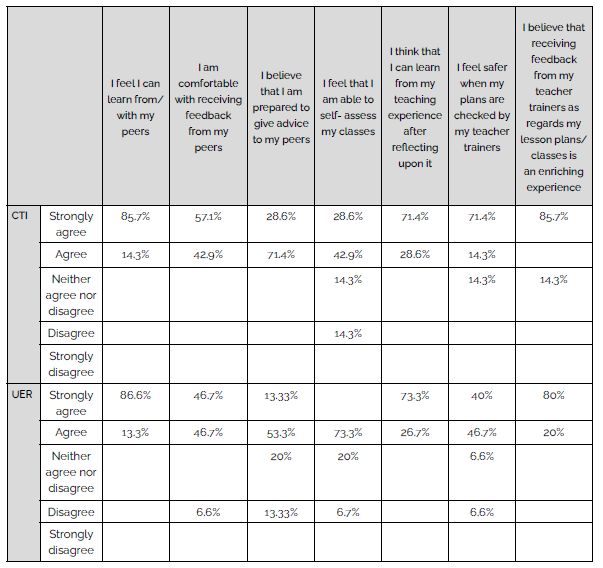
This
information was relevant to see whether StTs were willing to
collaborate with others, mainly the peers with whom they would be
co-teaching. Most StTs recognized the value of learning from peers,
being open to peer feedback, and assessing their own classes. Expert
mediation, particularly through feedback from teacher trainers, was
seen as beneficial and contributed positively to their professional
identity. However, there were variations in responses, indicating
that perceptions of mediation in the teaching profession are
individualized and influenced by diverse attitudes. Notably, there
was a trend toward reduced willingness to engage in self-assessment
and provide constructive feedback to peers. Mentor mediation was
found to have a significant influence, suggesting that mentorship
plays a crucial role in shaping the professional perceptions of
future educators and that mentors need to provide StTs with tools so
they do not grow dependent on their mentors and can continue their
long-lasting learning path with the help of meaningful members of
their educational community.
Implementation
of the ENABLE Model and Teaching Practicum
During the implementation of the ENABLE model, StTs focused on using core practices and concepts, receiving feedback from mentors, peers, and host teachers, and engaging in reflection to make context-sensitive decisions. The observation period revealed that StTs had difficulty identifying core concepts and practices, particularly in the case of the CTI context. This lack of access to core knowledge hindered their ability to engage in meaningful discussions about pedagogy and methodology. In both contexts, the implementation of the ENABLE model was crucial in helping StTs solidify core concepts and practices, especially considering the diverse backgrounds and trajectories within the group as reflected in this remark: “I believe that this principled experimentation has provided me with an enriching experience that will help me consider many aspects of students when it comes to planning topics that are relevant and necessary for them" (UER6).
Observation and content analysis showed that StTs were more aware of practical issues rather than theoretical ones. In the Learning to See and Learning to Do stages, StTs actively worked with their peers to establish meaningful connections between relevant theories and the practical activities they had to solve. During the initial phase, Learning to See, StTs demonstrated a general understanding of effective classroom management principles, but they sometimes struggled to articulate these principles using precise terminology. Some StTs faced challenges in bridging the gap between theory and practice and required additional mentor mediation. For example, when discussing their lesson plans, student teachers described their educational instructional decisions in vague terms, such as using interesting activities or keeping students engaged, without reference to methodological principles. There were also initial hesitations and reluctance in providing feedback among peers, maybe stemming from their lack of confidence in their handling of theory. Field notes indicated that in group planning sessions, questions such as “should we use a task-based activity here or something simpler?” (CTI2) were frequently directed at teacher educators rather than discussed among peers.
Throughout the implementation of the ENABLE model, StTs gradually improved their ability to connect theory with practice in the design and delivery of speaking, reading, and listening activities. Early on, they often relied on familiar lesson formats, sometimes replicating them without fully considering their students' specific needs, and showed hesitation when giving peer feedback, reflecting uncertainty in their professional roles. Mentor mediation was key in guiding them to experiment with more flexible and context-sensitive approaches. Over time, they demonstrated greater confidence, motivation, and ownership of their professional growth.
Classroom observations conducted by the StTs themselves played a vital role in their development, offering insight into practical teaching strategies and classroom dynamics. However, some StTs initially struggled to identify the components of effective teaching when using the observation rubric. The practicum period was significant for StTs to apply what they had learned through the ENABLE model. They co-taught and then taught solo, designing a series of lessons and reflecting on their performance. Feedback from teacher educators, host teachers, and peer student teachers acting as mentors supported their development.
Overall, the implementation of the ENABLE model and the use of various strategies—such as observation, feedback, reflection, and peer mediation—supported StTs in developing core practices and concepts. The model helped bridge the gap between theory and practice and facilitated the growth of StTs' professional identities. Through these experiences, StTs gained a deeper understanding of effective teaching strategies and approaches, as well as the importance of context and student-centeredness in their instructional practices.
Their reflections show increased awareness of the social dimension of teaching and the value of responsiveness to learners’ realities. For instance, one student teacher reflected:
I have taught in different institutions but I would like to concentrate on one of them: ESJA, which I consider significant due to the different social realities within a classroom and the challenge that it meant to me. For instance, help students be aware of the importance of learning English. (UER6)
Similarly, another commented on the broader role of education by highlighting that: "Escuela de Jóvenes y Adultos N° 12 (ESJA) [...] offers adults who didn’t have the possibility to study a great place to do it, taking into account that they work and have families" (UER2).
The importance of affective and reciprocal teaching was also noted: "I have also learnt that we can gain knowledge from students while facing different realities, and with only one class you can make their day" (UER5). These voices illustrate how contextualized teaching experiences can transform pre-service teachers' perspectives and reinforce their commitment to inclusive, student-centered education.
Student
Teachers’ Identity: Final Reflection
Towards the end of the academic year, StTs were required to compose a final reflection using a designated reflection framework as a guiding tool. These reflections were submitted through the virtual classroom platform. Subsequently, an interview was conducted to delve into any concerns or considerations related to the evolution of their professional identity.
During the reflection, StTs were prompted to engage in introspection regarding their professional identity. Within the CTI context, where StTs are in the initial stages of their professional practice, there was a tendency among participants to associate professionalism with the specific tasks and responsibilities inherent to teaching. For instance, they highlighted the importance of “planning engaging activities, effectively managing classroom dynamics and student behavior, delivering instructions in a compelling manner, and providing adequate support to facilitate student learning” (CTI6). While it is evident that StTs still have room for further reflection on the multifaceted nature of teacher identity, their progress thus far indicates a positive trajectory.
It is possible to see that StTs become more aware of the importance of engaging in the reflection process in the following piece of data:
I realized that lesson planning is key to a successful class since you go with a goal in mind and after the class you can self-evaluate and see which goals were achieved and which aspects should be improved. Also, you go to class prepared for different situations that may happen. (CTI1)
During the analysis of factors contributing to the success of an activity, a StT emphasized the significance of utilizing games not only to enhance language development in a welcoming environment but also to facilitate the acquisition of supplementary skills beyond the academic curriculum. This includes the cultivation of “social skills, problem-solving abilities, and the establishment of a sense of community, all while engaging with core subject matter” (CTI1). This observation indicates that StTs are considering their role not solely as language instructors, but as educators who prioritize the holistic development of the child. For some StTs, mentoring played an important role, as host teachers, peers and teacher educators could suggest activities or adaptations to the activities proposed by StTs to make them suitable for their own teaching context.
A StT highlighted the importance of considering theoretical aspects when instructing children:
These core concepts provided me with insight into the teaching process for children and the planning of suitable lessons. Taking these core concepts into account necessitated considering the type of activities to implement, as well as the cognitive development, needs, and interests of the students. (CTI5)
Another StT expressed a desire to be recognized as someone who values the emotions and feelings of their students: "I want my students to feel assured that I am there to listen to them and assist them to the best of my abilities" (CTI4). Additionally, StTs acknowledged that for activities to be effective, they must serve a purpose and relate to students' lives. This may require significant effort on the part of the teacher to employ diverse teaching strategies that make each task approachable and interesting for their students (CTI1). These comments provide evidence that StTs are already considering a range of factors when planning and delivering lessons. This is further demonstrated in their description of a successful activity, such as the "magic box, which sparked curiosity, contextualized language, provided language exposure, promoted student participation, and fostered a learner-friendly atmosphere” (CTI5). In this way, StTs used their theoretical knowledge and put it into practice.
By the end of the year, after sustained engagement in reflexive practices related to pedagogy, methodology, and classroom experience, some student teachers expressed an increased awareness of their professional growth. As one participant noted, “Now, I am about to become a teacher, which made me find a better version of myself” (CTI2).
In the next piece of data, the StT reflects:
I want to be a teacher who helps them enjoy the subject and the time we are together. I want to be a teacher who transmits to them the joy, the importance, and the feeling of learning English. I want to be a significant person to them either as a teacher or just as a nice person they have met sometime. I want to be remembered as a kind and helpful teacher and, if possible, as the teacher who could change their view about studying and learning. I want them to notice and realize the importance of learning and I want them to want to learn, to progress and to achieve goals. (CTI5)
This comment evidences that StTs perceived their professional identity as encompassing more than the acquisition of core concepts and practices, as they also considered socio-affective aspects such as empathy, encouragement, and student well-being. This alignment between personal values and projected teaching roles is a key feature of early identity formation, where becoming a teacher is shaped as much by who they aspire to be as by what they know how to do.
Regarding the UER context, the final reflections revealed that, although StTs often confused core practices and core concepts when categorizing them, most were able to apply during their both teaching practice and performance review process.
The reflective writings prompted StTs to examine themselves across different teaching contexts, indicating the development of an evolving professional identity. It is worth noting that, for these student teachers, professional identity is framed by a commitment to meaningful practices and specific strategies or core practices that they perceive as having a potential impact on their future students’ learning and attitudes.
I’d like to keep on working with interesting contexts for students as it is great what they can do if they care and are engaged with the final product… it is important to take into account their interest and different realities when we think about a topic, context and types of activities, it needs to be meaningful for them. (UER2)
Their awareness of the importance of making content meaningful reflects a shift toward a more relational and student-responsive view of teaching. This suggests an alignment between their emerging values and teaching practices, which is central to teacher identity formation.
StTs identified key elements that contributed to their development, such as planning, observation, and reflective practice. One participant remarked, “The observation, planning, and organization of activities played a crucial role in ensuring a positive class delivery experience” (UER8), highlighting the value of preparation. Another noted, “I believe that this principled experimentation has provided me with self-confidence” (UER1), pointing to the ENABLE model's role in fostering a sense of agency and ownership over their professional growth. It is evident that StTs perceived the teacher’s role as fundamental in student growth and achievement, and as a core component in the development of their professional identity based on core practices.
In line with Kaya and Dikilitaş (2019), reflection on StTs’ praxis contributed to the construction of their personal identity and assisted in improving their self-awareness, giving significance to instructing and evaluating the effectiveness of classroom strategies. However, considering that professional identity comprises many more aspects, StTs still need to develop a sound understanding of it in order to empower their performance by aligning “who I am” with “what I do” (Mockler, 2020, cited in Suarez & McGrath, 2022). The development of StTs’ identity is intricately shaped by various factors, including their educational contexts, prior experiences, and participation in learning communities (Izadinia, 2013). As articulated by one of the StTs: “Teaching is a lifestyle. To teach is to be constantly learning new valuable things from others. To teach is to be conscious of every minute you spend inside and outside your classroom” (UER5).
This perspective highlights the continuous process of learning and growth inherent in teaching, wherein practicing teachers are constantly exposed to new knowledge and experiences from diverse sources. Moreover, it signifies a heightened awareness of the interplay between personal development and professional efficacy, emphasizing the significance of integrating both aspects in the journey towards becoming well-rounded educators.
Overall, the responses demonstrate an insightful understanding of the complexities involved in StTs’ identity development, emphasizing the importance of ongoing professional learning, reflection, and awareness in shaping one’s identity as a teacher.
The objective of this study was to examine the ways in which StTs could explore their professional identity through the utilization of the ENABLE model. The transformation of professional identity is illustrated in Figure 3, which represents StTs’ journey throughout the academic year.
Figure
3
Key
factors supporting student teacher development (Graphic created by
the authors based on the Learning to Become stage proposed by Diaz
Maggioli, 2022)
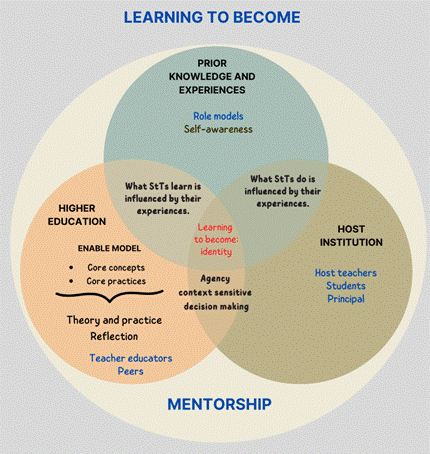
Figure
3 attempts to explain the process of StTs’ identity construction in
two methodology courses that implemented the ENABLE model to provide
StTs with the knowledge and skills needed for their teaching practice
and to support the development of their professional identity. As
Diaz Maggioli (2022) states, the prior knowledge and experiences that
StTs bring to the classroom—as well as their decision to study to
become teachers—may have been influenced by people they perceived
as role models.
StTs’ professional identity was shaped by their own personal and teaching experiences as additional language learners and by the relationships they established with their teacher educators throughout their degree programs. They also developed self-awareness, as their emotions, thoughts, and actions heavily influenced their vision of the type of teachers they aspired to become. As one participant expressed: “I want to be remembered as a kind and helpful teacher and, if possible, as the teacher who could change their view about studying and learning. I want them to want to learn, to progress and to achieve goals” (CTI5).
By completing teaching sequences grounded in the ENABLE cycle, StTs focused on core concepts and core practices, which enabled them to analyse their prior experiences and enhance their ability to make informed decisions (Beijaard et al., 2004). The teaching practicum served as a platform for StTs to challenge their existing knowledge, think critically, and co-construct knowledge with the guidance of mentors. This process enriched their understanding of teaching and of how they perceived themselves within the profession.
Effective learning opportunities tailored to specific contexts had a strong impact on the development of teacher cognition through self-exploration, reflective thinking, and critical analysis of teaching practices. Mediators, such as teacher educators, provided well-designed materials and activities to help connect theory with everyday teaching practice. They played a key role by inviting StTs to question their knowledge and beliefs, rethink how they performed certain tasks, and reflect on how their own experiences influenced their decisions.
At the end of the academic year, StTs could gain pedagogical content knowledge, and they started to develop a sense of agency, and self-awareness, which in turn boosted their confidence. The relationships with peers, students, host teachers and mentors had an impact on their professional development, evident in this reflection:
I am committed to maintaining a growth mindset and actively pursuing further development [...] I recognize that it is an ongoing process, and I am eager to embrace new opportunities to grow and improve. I will continue to engage myself in reflective practice, seeking feedback from colleagues, mentors, and students to refine my teaching approaches. By remaining open to new ideas, incorporating innovative strategies, and staying abreast of current research and best practices in education, I am confident that I will be evolving as a teacher. (UER8)
As stated by Izadinia (2013), StTs’ professional identity is influenced by their educational contexts, prior experiences, and participation in learning communities. As one participant expressed: “I want to become a better teacher to help students from state-run schools who have limited opportunities to move up the social ladder, to receive high-quality education, to promote social mobility” (CTI3).
Teacher identity is not a fixed construct but rather a dynamic entity, continuously shaped and reshaped throughout the active process of learning to teach (Trent, 2010, cited in Izadinia, 2013), particularly in real-world contexts (Beauchamp & Thomas, 2009). As shown in the intersection areas of the chart, the teaching practicum allows StTs to reassess their beliefs, analyze their prior experiences, and reflect on their teaching practices—as both teachers and students—in light of the theory and practice learned in their teacher education programs. This constant flow of experiences and reflection meant that StTs’ professional identity was in a continuous process of construction and reconstruction.
Thus, gaining a deeper understanding of the intricate process of identity formation among StTs can greatly influence the design and implementation of effective teacher education programs (Beauchamp & Thomas, 2009). In this regard, it becomes essential to consider more deeply what should be included in order for student teachers to explore the factors that may contribute to their professional identity beyond classroom management.
The exploration of professional identity began with an initial questionnaire assessing StTs’ prior knowledge and experiences. Through ENABLE-based sequences, they engaged in discussions using appropriate language for teaching scenarios. As they took on responsibilities in host schools, their identity evolved through the application of theoretical and practical knowledge in lesson planning and classroom decision-making. The teaching practicum provided opportunities for StTs to observe different teachers, gain insights into their relationships with various stakeholders (students, principals, host teachers, etc.), and further develop their professional identity.
Consistent with Izadinia (2016) and Díaz Maggioli (2022), mentors have a significant impact on the formation of StTs’ professional identity. They assist students in directing their attention, facilitating reflective practices, encouraging observation and guided practice, fostering meaningful interactions, and supporting lesson planning and effective class delivery. Additionally, mentors help students identify areas for improvement by highlighting specific student needs. However, it is important to note that not all StTs engaged in discussions at the same level of depth, as the development of teacher identity depended on their commitment to the reflection process, engagement in lesson planning and delivery, collaboration with peers and mentors, and understanding of core concepts and practices (Chu, 2020). In other words, the process of identity development is highly personal.
Thus, gaining a deeper understanding of the intricate process of identity formation among StTs can greatly influence the design and implementation of effective teacher education programmes (Beauchamp & Thomas, 2009). In this case, we need to consider at a deeper level what should be included for student teachers to explore factors that may contribute to their professional identity beyond classroom management.
Professional identity exploration began with an initial questionnaire assessing StTs’ prior knowledge and experiences. Through ENABLE-based sequences, they engaged in discussions using appropriate language for teaching scenarios. As they took on responsibilities in host schools, their identity evolved through applying theoretical and practical knowledge in lesson planning and classroom decision-making. The teaching practice provided opportunities for StTs to observe different teachers, gain insights into their relationships with various stakeholders (students, principals, host teachers, etc.), and further develop their professional identity.
Consistent with Izadinia (2016) and Diaz Maggioli (2022), mentors have a significant impact on the formation of StTs’ professional identity. They assist students in guiding their attention, facilitating reflective practices, encouraging observation and guided practice, fostering meaningful interactions, and supporting the creation of lesson plans and effective class delivery. Additionally, mentors help students identify areas for improvement by drawing attention to specific student needs. However, it is important to note that not all StTs engaged in discussions at the same level of depth, as the development of teacher identity depended on their commitment to the reflection process, engagement in lesson planning and delivery, collaboration with peers and mentors, and understanding of core concepts and practices (Chu, 2020). In other words, the process of identity development is highly personal.
While StTs tended to associate their teacher identity with specific actions, such as creating engaging activities and fostering a learner-friendly environment, little attention was given to other components of teacher identity, including ideology, politics, sociocultural background, and more. Several reasons may account for this.
First, in the CTI context, StTs had not yet taken modules related to ethics and comprehensive sexual education. Even though they had taken courses on Argentinian history, these focused on presenting historical facts rather than problematizing the teacher’s role in nation-building. This may have limited the way StTs viewed themselves and their profession.
Second, although StTs were exposed to a variety of teaching materials, most ready-available resources did not focus on topics such as diversity and integration. Tutorials on popular streaming platforms—often consulted by StTs—tended to prioritize content delivery and skills development. Additionally, limited class time may have prevented teacher educators from discussing teaching materials in terms of representation, equity, inclusion, and diversity in sufficient depth.
Finally, StTs are likely to invest time in learning what they perceive to be important. During the teaching practicum, designing a lesson plan and delivering a class may seem more urgent or relevant than engaging in deeper reflection on educational philosophies. Therefore, upon completing their educational programmes, StTs still find themselves in an ongoing process of examining and refining their identities as educators, navigating between curricular demands and the sociocultural responsibilities of teaching.
This article aimed to demonstrate that the ENABLE model played a substantial role in paving the way for StTs’ professional development. Through the activities embedded in the teaching sequences, StTs were able to assess the impact of prior knowledge and experience in light of the core concepts and practices introduced, as well as the new experiences gained in both their methods classes and teaching practicum. This identity construction process was, in their words, greatly supported by their mentors, who provided guidance, encouragement, and sustained pedagogical support throughout their learning journey.
In conclusion, this article has explored the process of constructing the professional identity of student teachers (StTs) through the implementation of the ENABLE model in two methodology courses. The findings demonstrate that StTs can effectively develop their professional identity by engaging with core concepts and practices, reflecting critically, and co-constructing knowledge with the support of mentors.
The study also underscores the relevance of the teaching practicum as a space for challenging prior assumptions, strengthening self-confidence, and fostering agency and self-awareness. Interactions with peers, students, host teachers, and mentors played a key role in shaping StTs’ professional development. Moreover, previous experiences, learning communities, and the broader educational context significantly influenced the formation of their emerging professional identities.
However, by the end of the year, it became apparent that some aspects of professional identity—such as ideology, politics, and sociocultural awareness—remained underdeveloped. This could be attributed to several factors: the limited availability of teaching materials that encourage critical engagement with sociopolitical themes, time constraints that reduce opportunities for in-depth discussion on issues like representation, equity, and inclusion, and StTs’ own perceptions of what is necessary to succeed in their practicum.
Overall, this study highlights the need for teacher education programs to purposefully integrate spaces for identity exploration that go beyond classroom management. The ENABLE model proved to be a valuable tool for fostering reflection, informed decision-making, and the gradual development of a teaching identity. Equally important was the role of mentors, who provided critical guidance, emotional support, and opportunities for dialogue and feedback throughout the learning process.
Future research should continue to examine how teacher identity can be nurtured in more holistic ways, incorporating ethical, political, and sociocultural dimensions. A deeper understanding of these processes will contribute to the design of more empowering and responsive teacher education programs, while also enriching the academic literature on professional identity development. These insights are particularly relevant for teacher educators, curriculum designers, and policymakers seeking to promote pedagogical excellence alongside critical professional awareness.
Notes:
Final
approval of the article:
Verónica
Zorrilla de San Martín, PhD, Editor in Charge of the journal.
Authorship
contribution:
Ana
Cecilia Cad: conceptualization, data curation, research, methodology,
administration, resource management, supervision, writing of the
draft and review of the manuscript.
Sonia Vanesa Cladera:
conceptualization, data curation, research, methodology, resource
management, supervision, visualization, writing of the draft and
review of the manuscript.
Maria de los Ángeles Bortagaray:
conceptualization, data curation, research, methodology,
administration, resource management, supervision, writing of the
draft and review of the manuscript.
Availability
of data:
The
dataset supporting the findings of this study is not publicly
available.
Beijaard, D., Meijer, P. C., & Verloop, N. (2004). Reconsidering research on teachers’ professional identity. Teaching and Teacher Education, 20(2), 107-128. https://doi.org/10.1016/j.tate.2003.07.001
Beauchamp, C., & Thomas, L. (2009). Understanding teacher identity: An overview of issues in the literature and implications for teacher education. Cambridge Journal of Education, 39(2), 175–189. https://doi.org/10.1080/03057640902902252
Chu, Y. (2020). Preservice teachers learning to teach and developing teacher identity in a teacher residency. Teaching Education, 32(3), 269-285. https://doi.org/10.1080/10476210.2020.1724934
Cuadra-Martínez, D., Castro-Carrasco, P., Oyanadel-Véliz, C., González-Palta, I., Živković, P., Sandoval-Díaz, J., & Pérez-Zapata, D. (2023). Preservice teacher professional identity: Influence of the teacher educator and the teacher education model. Education Policy Analysis Archives, 31(86), 2-22. https://doi.org/10.14507/epaa.31.7631
Cochran-Smith, M., & Lytle, S. L. (2009). Inquiry as stance: Practitioner research for the next generation. Teachers College Press.
Corbin, J., & Strauss, A. L. (2015). Basics of qualitative research: Techniques and procedures for developing grounded theory (4th ed.). SAGE.
Creswell, J. W., & Poth, C. N. (2017). Qualitative inquiry and research design: Choosing among five approaches (4th ed.). SAGE.
Díaz Maggioli, G. (2022). Initial language teacher education (1st edition). Routledge.
Grossman, P. (2018). Teaching core practices in teacher education. Harvard Education Press.
Izadinia, M. (2013). A review of research on student teachers’ professional identity. British Educational Research Journal, 39(4) 694-713. https://doi.org/10.1080/01411926.2012.679614
Izadinia, M. (2016). Preservice teachers’ professional identity development and the role of mentor teachers. International Journal of Mentoring and Coaching in Education, 5(2), 127-143. https://doi.org/10.1108/IJMCE-01-2016-0004
Hanna, F., Oostdam, R., Severiens, S., & Zijlstra, B. (2020). Assessing the professional identity of primary student teachers: Design and validation of the Teacher Identity Measurement Scale. Studies in Educational Evaluation, 64, 1-10. https://doi.org/10.1016/j.stueduc.2019.100822
Huu Nghia, T., & Ngoc Tai, H. (2017). Preservice Teachers’ Identity Development during the Teaching Internship. Australian Journal of Teacher Education, 42(8), 1-15. http://dx.doi.org/10.14221/ajte.2017v42n8.1
Kaya, M., & Dikilitaş, K. (2019). Constructing, Reconstructing and Developing Teacher Identity in Supportive Contexts. The Asian EFL Journal, 21(1), 58-83.
Korthagen, F., & Vasalos, A. (2005). Levels in reflection: Core reflection as a means to enhance professional growth. Teachers and Teaching, 11(1), 47–71. https://doi.org/10.1080/1354060042000337093
Mockler, N. (2011). Beyond ‘what works’: Understanding teacher identity as a practical and political tool. Teachers and Teaching, 17(5), 517-528. https://doi.org/10.1080/13540602.2011.602059
Sammons, P., Day, C., Kington, A., Gu, Q., Stobart, G., & Smees, R. (2007). Exploring variations in teachers' work, lives and their effects on pupils: Key findings and implications from a longitudinal mixed‐method study. British Educational Research Journal, 33(5), 681-701. https://doi.org/10.1080/01411920701582264
Suárez, V., & McGrath, J. (2022). Teacher professional identity: How to develop and support it in times of change (OECD Education Working Papers No. 267). OECD Publishing. https://doi.org/10.1787/b19f5af7-en
Torres Cepeda, N. M., & Ramos Holguín, B. (2021). The dynamic process of student-teachers’ construction of identity as future teachers. Cuadernos De Lingüística Hispánica, 38, 1–20. https://doi.org/10.19053/0121053X.n38.2021.11205