Politicizing
edible insects
A
mediatized identity politicsi
Politización
de los insectos comestibles
Una política identitaria
mediatizada
Politizando
insetos comestíveis
Uma política identitária mediatizada
DOI:
https://doi.org/10.18861/ic.2026.21.1.4272
ILYA
KIRIYA
ilia.kiriia@univ-grenoble-alpes.fr – Grenoble – Université Grenoble Alpes, France.
ORCID: https://orcid.org/0000-0002-6305-0836
HOW
TO CITE: Kiriya,
I. (2026).
Politicizing edible insects. A mediatized identity politics.
InMediaciones
de la Comunicación, 21(1).
https://doi.org/10.18861/ic.2026.21.1.4272
Submission
date: September 15, 2025
Acceptance date: December 16, 2025
ABSTRACT
Since 2020, the issue of edible insects —whose consumption is authorized in many countries— has acquired notable centrality within the agricultural and nutritional policies of several nation-states. Their innovative character, positive environmental impact, and potential to address the global protein shortage are frequently emphasized in progressive and academic discourse. However, the promotion of edible insects has also emerged as a field of political controversy. Certain radical populist movements around the world have articulated this issue as a symbol of “wokeness”, “globalization” and “tolerance”, and have actively opposed its public legitimation. In this article, we analyze these discursive strategies on the basis of a corpus of media publications from nine countries. Drawing on discourse analysis grounded in the model developed by Laclau and Mouffe, we argue that radical right groups exploit the issue of edible insects as a tool of identity politics. The elements of this identity politics are relatively consistent and can be identified across different parts of the world, including the discourse of Americans Trumpists, Hungarian populists and Italian far-right forces.
KEYWORDS: media, populism, entomophagy, progressist discourse, traditionalist discourse, mediatization.
RESUMEN
Desde 2020, el tema de los insectos comestibles —cuyo consumo está autorizado en muchos países— ha adquirido una centralidad notoria en las políticas agrícolas y nutricionales de varios Estados nacionales. Su naturaleza innovadora, su impacto ambiental positivo y su potencial para abordar la escasez global de proteínas se destacan a menudo en el discurso progresista y académico. Sin embargo, la promoción de los insectos comestibles se ha constituido asimismo en un campo de controversia política. Ciertos movimientos populistas radicales en todo el mundo han articulado esta cuestión como un símbolo de la “wokeness”, la “globalización” y la “tolerancia”, y han desplegado una oposición activa a su legitimación pública. En este artículo, analizamos estas estrategias discursivas con base en un corpus de publicaciones en medios de comunicación de nueve países. A través del análisis del discurso basado en el modelo de Laclau y Mouffe, observamos que los grupos radicales de derecha explotan el tema de los insectos comestibles como una herramienta de política identitaria. Los elementos de esta política identitaria son relativamente consistentes y pueden encontrarse en diferentes partes del mundo: en el discurso de los trumpistas estadounidenses, los populistas húngaros y las fuerzas de extrema derecha italianas.
PALABRAS CLAVE: medios, populismo, entomofagia, discurso progresista, discurso tradicionalista, mediatización
RESUMO
Desde 2020, a questão dos insetos comestíveis —autorizados em muitos países— tornou-se um tema importante nas políticas agrícolas e nutricionais de vários estados. Sua natureza inovadora, impacto ambiental positivo e potencial para lidar com a escassez global de proteínas são frequentemente destacados no discurso progressista e acadêmico. No entanto, o tema dos insetos comestíveis também surgiu como uma questão política significativa. Certos movimentos populistas radicais em todo o mundo o enquadraram como um símbolo de “wokeness”, “globalização” e “tolerância” e se opuseram ativamente a ele. Neste artigo, analisamos essas estratégias discursivas a partir de um corpus de publicações midiáticas de 9 países. Por meio da análise do discurso com base no modelo de Laclau e Mouffe, observamos que grupos radicais de direita exploram a questão dos insetos comestíveis como ferramenta de política identitária. Os elementos dessa política de identidade são relativamente consistentes e podem ser encontrados em diferentes partes do mundo —no discurso dos trumpistas americanos, populistas húngaros e forças de extrema-direita italianas.
PALAVRAS-CHAVE: mídia, populismo, entomofagia, discurso progressista, discurso tradicionalista, midiatização.
1. INTRODUCTION
Since 2015, numerous European regulations authorizing the importation, production, and consumption of edible insects as food have been adopted. That year, the European Food Safety Authority (EFSA) published its first scientific report assessing the risks of consuming insects as comparable to those of conventional foods and established a procedure for authorizing this new category of food within the European Union (EU) (EFSA Scientific Committee, 2015). Since then, any insect-based product entering the EU market has been subject to individual authorization.
This changed in 2021, when the European Commission simultaneously approved several insect species for the food market: Tenebrio molitor larvae (yellow mealworm), Locusta migratoria (migratory locust), and Acheta domesticus (house cricket) (Mancini et al., 2022). This shift in regulatory policy is closely linked to various environmental and economic arguments, such as the potential to address the global protein shortage (Henchion et al., 2017) and to reduce CO₂ emissions —given that producing equivalent amounts of insect protein requires significantly less energy than beef or other conventional protein sources (Medek, Schwartz & Myers, 2017)—. Despite these developments, the scale of entomophagy in the European market remains relatively limited. Nonetheless, market growth projections remain optimistic (Mancini et al., 2022).
The social discourse promoting entomophagy is largely shaped by a progressive and globalized ideological framework. It is generally acknowledged that Western societies face fewer issues regarding access to traditional protein sources, whereas such difficulties are more prevalent in poorer countries with larger populations. From this perspective, the promotion of insect-based foods may be interpreted as an appeal by Northern countries to address problems that are not directly their own— a dynamic comparable to transnational environmental discourses surrounding CO₂ reduction. In this sense, entomophagy-related discourse proves particularly susceptible to politicization, especially within anti-globalist and sovereignty-oriented narratives that are increasingly prominent in contemporary political agendas.
Another factor contributing to the politicization of this discourse lies in the intrinsically social character of food consumption, which is deeply influenced by cultural and societal norms. For instance, even among indigenous populations with historical traditions of insect consumption, contemporary willingness to consume insects varies according to social status. Among urbanized and educated communities, traditional entomophagy is often perceived as “rural” or “primitive” (Wang & Shelomi, 2017). More broadly, food constitutes a fundamental aspect of everyday life —encompassing practices such as cooking, purchasing, and growing— and thus functions as a powerful social marker. As a result, food practices can easily become sites of ideological conflict, as illustrated by debates between vegetarians, vegans and “vegephobes” (Carrié, 2018).
A key mechanism facilitating the migration of discourse between political, scientific and medical realms is what is referred to as mediatization —the process by which media logic becomes integrated into other social institutions (Altheide & Snow, 1979; Hjarvard, 2008)—. Far-right and populist political strategies rely heavily on the mediatization of political discourse, particularly in their efforts to “other” counter-identities and frame themselves as the sole legitimate representatives of “the people” (Müller, 2016). These strategies are further amplified by the negative dynamics of social media and digital platforms —such as filter bubbles and the blurring boundaries between journalism and partisanship— which contribute to the circulation of conspiracy theories and moral panics, including those related to food consumption and health (Bennett & Livingstone, 2018).
In this paper, we analyze such discursive strategies in online media from nine countries. Our basic hypothesis may be formulated as follows: the issue of entomophagy is highly polarized within the political field and represents an important symbolic resource for opposing political forces. The objective of our paper is to identify common patterns in how this issue is mobilized across political discourse in national contexts.
2.
FOOD AND HEALTH PRACTICES AS MEDIATIZATION OF POLITICS: A REVIEW
Historically, the question of what and how we eat has been central to what is commonly understood as cultural identity, and, as such, is imbued with symbolic significance (Parés i Maicas, 1996). Food represents an important marker of social and cultural belonging: “we mark our membership in a culture or group by asserting the specificity of what [we] eat” (Fischler, 1988, p. 278). From this perspective, food practices carry a strong potential for politicization, as “cultural identity” is often a trigger for political discourse.
The late 20th century was marked by a series of public health crises related to food, including widespread concern over genetically modified organisms (GMOs) and the “Mad Cow” crisis in France and the United Kingdom (UK). These events contributed to the consolidation of a strong link between food safety and public health, while also sparking criticism regarding animal welfare in industrial farming and environmental concerns in food production (De Oliveira & Clavier, 2025). As such issues increasingly influence public policy, they also contribute to the politicization of food. Innovations in genetics, food production, and regulatory frameworks further reshape identity narratives in novel and often contested ways (Bliss, 2013).
The COVID-19 pandemic provides a recent and salient example of the politicization of public health. Many high-profile political figures propagated conspiratorial narratives surrounding the pandemic, and political affiliation played a decisive role in shaping public belief systems (DeYoung & Farmer, 2023; Mariani, Gagete-Miranda & Retti, 2020). Based on these precedents, we hypothesize that a similar process of politicization will be observable in relation to entomophagy, when framed as a public health issue within media discourse.
Several features of the contemporary mediatized political environment influence how public health becomes a subject of political discourse. First, there is an erosion of boundaries between traditional journalism —understood as multi-perspectival reporting—, partisan journalism, and activism, a phenomenon that Bennett & Livingstone (2018) conceptualize as the “alt-right disinformation order”. As a result, public health discourses are increasingly produced not by authoritative actors or health institutions, but by politically motivated figures who instrumentalize such topics to advance ideological agendas.
Fabio Parasecoli (2022) introduces the concept of gastronativism, defined as the the ideological use of food to assert who belongs to a community and who does not. As he notes: “The Italian political right is outraged by halal tortellini and a pork-free lasagna served at the Vatican. In India, Hindu fundamentalists organize attacks on Muslims who sell beef. European anti-immigrant politicians denounce couscous and kebabs” (Parasecoli, 2022).
Second, the digital media environment undermines trust in traditional sources of authority (Bennett & Livingstone, 2020; Farkas & Schou, 2020). Yet this phenomenon is not solely technologically driven. It reflects a broader, decades-long decline in trust in political institutions, the rise of neoliberal policies, and the resulting erosion of support for centrist parties (Bennett & Livingstone, 2018). Colin Crouch (2004) captured these dynamics under the concept of post-democracy long before the mainstreaming of Web 2.0.
Third, the architecture of the modern, collaborative web actively reinforces these dynamics. Theories such as filter bubbles (Pariser, 2012) and echo chambers (Gentzkow & Shapiro, 2011) describe how users cluster around ideologically similar content and communities. In the context of food, this may facilitate the formation of conspiracy theories (Giry, 2023) and the polarization of groups based on dietary or health-related identities. The anti-vaccine movement during COVID-19 is a paradigmatic example, and has been extensively documented in the literature. Allcott et al. (2020), for instance, found significant partisan differences in adherence to social distancing measures.
This digitally polarized environment is often described as inherently populist. According to Jan-Werner Müller, populism is
a particular moralistic imagination of politics, a way of perceiving the political world that sets a morally pure and fully unified - but ultimately fictional - ‘people’ against elites who are deemed corrupt or morally inferior. (Müller, 2016, pp. 19-20)
Digital platforms enable populist politicians to identify and engage with supporters more effectively (Maly, 2018), amplifying highly visible, “liked,” and emotionally resonant content. This dynamic, rooted in what van Dijk (2013) terms the neoliberal logics of platform affordances, privileges visibility over veracity. Populism, by nature, relies on identity politics, which is fundamentally discursive. It constructs a morally superior notion of “people”, whose interests populist actors claim to defend, and opposes them to a range of constructed “others” such as elites, migrants, or cultural outsiders. Given that food and health are deeply tied to identity, they become attractive tools for populist mobilization.
As Giry (2023) observes, food-related anecdotes
tackle identity issues when they either affirm that foreigners eat, or make others unwittingly eat, disgusting, gross, ugly, suspicious or inedible things. Or they tackle identity issues by serving as quasi-mythical symbols and allegories for cultural and political foundations or unifications. In this mode, national or local food habits are praised and presented as righteous and safe. (p. 10)
These identity narratives are frequently transformed into popular conspiracies by what Giry calls political entrepreneurs.
To analyze these discourses, we draw on the theoretical framework of Ernesto Laclau and Chantal Mouffe (1985), who argue that social meanings are not fixed but emerge through articulatory practices. Laclau (2005) further proposes that populism is not tied to a specific ideology or social base, but is instead a discursive logic. In this view, populism operates through the rhetorical construction of a unified “people” in opposition to a “power” which may be considered as “different elite groups” in populist narratives. Thus, meanings are not predetermined but emerge in opposition to excluded alternatives: “A discourse is always constituted in relation to what it excludes, that is, in relation to the field of discursivity” (Jørgensen & Phillips, 2002, p. 27).
When a discourse labels a particular food as “non-traditional” or “unrepresentative of national identity,” it mobilizes floating signifiers (in terms of Laclau and Mouffe “empty signifiers”) such as traditional/non-traditional or national/foreign. These signifiers are filled with meaning by specific political actors who seek to establish hegemonic discursive formations —that is, dominant interpretations of the world— by excluding competing meanings.
3.
METHODOLOGY
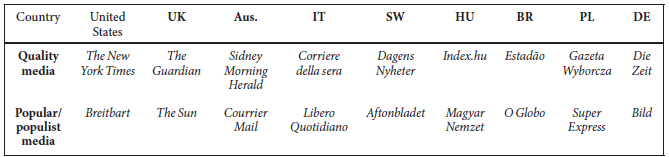
To examine the discourse surrounding edible insects and its politicization, we analyzed a corpus of 150 publications from online media in nine countries: the United States, the UK, Australia (Aus.), Italy (IT), Sweden (SW), Hungary (HU), Brazil (BR), Poland (PL) and Germany (DE). These countries were selected due to the presence of documented populist tendencies, which have often facilitated the rise to power of conservative or far-right parties. In each country, we chose two news sources: a “quality” outlet (a well-known, reputable source of information) and a more “popular” or alternative outlet (typically a tabloid or a politically biased platform, often associated with far-right perspectives). Tabloids tend to frame stories in a provocative manner, leveraging populist narratives to capture readers’ attention, while quality journalism is generally considered more reflective and analytical toward populism (Bobba et al, 2025). That’s why we supposed it will demonstrate a notable cleavage in their narratives.
Texts were collected using Google News filters with the search terms “edible insects”, “eat insects” and “entomophagy”. The collection period spanned 1 January 2020 to 30 May 2024. The selected media outlets are listed in Table 1 below.
Table
1.
Main media outlets in final sample
Source: Prepared by the author.
The total number of publications varied across the selected outlets because, in some cases, the topic of entomophagy was only marginally addressed.
To analyze the discourse, we adopted the approach of Laclau and Mouffe (1985) as operationalized through the model proposed by Jørgensen and Phillips (2002). Entomophagy and its practices are considered as floating (or empty as called by Laclau) signifiers struggling for fixation of meaning. We identified nodal points, or key concepts, around which public discourse in each publication was organized. Similar meanings articulated across different publications were grouped into common discursive formations. These nodal points were examined in relation to their alternative meanings, that is, meanings excluded from articulation but that nevertheless remain part of the field of discursivity. Subsequently, we demonstrate how the media construct collective identities (self-identities of proponents) around issues such as edible insects and entomophagy, as well as how they delineate out-groups or antagonistic groups (constituting “collective other”) through these discursive formations. In populist theory of Laclau it’s the “way of constituting the very unity of the group” – “the people” (Laclau, 2005, p. 74). As Olga Baysha argues, “the people” of a populist movement appear when one unsatisfied popular demand comes to be united with other demands, and when these demands are “equivalently” united to oppose the established order (Baysha, 2022, p. 27).
4.
RESULTS
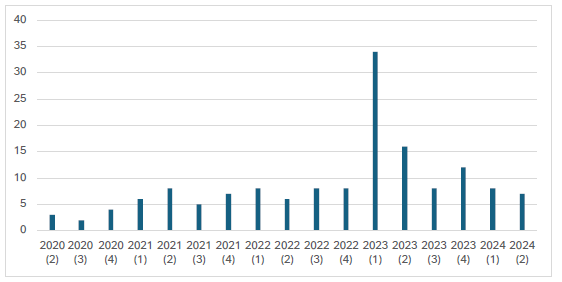
First of all, to characterize our corpus quantitatively we placed it on a time lapse (Figure 1).
Figure
1.
Number of publications per quarter or year
Source: Built on the basis of data collected by the author.
As we can observe, the highest concentration of publications on the topic of edible insects occurred during the first quarter of 2023. This surge coincided with the EU’s approval of two new insect-based food products: powdered house cricket and lesser mealworm. Although not unprecedented —since the EU had previously approved other insects for food (most notably the yellow mealworm in 2021)— these earlier authorizations did not attract a comparable level of media attention.
The 2023 decision, however, sparked an extensive wave of media discussions from both camps: proponents of insect-based foods on one side and opposing politicians and commentators on the other. Several events appeared to trigger this heightened interest, particularly by drawing the attention of right-wing populist politicians and media outlets critical of the EU’s decision. Such events included cases in UK schools (May 2022), Swiss schools (May 2023), and Polish schools (February 2023), where pupils were reportedly “sensitized” to the idea of incorporating insects into human diets. These incidents amplified the topic’s prominence in the media agenda.
Overall, the discourse within the analyzed media can be characterized as polarized around two opposing poles that construct “the other” and frame entomophagy as a political issue in markedly different ways. The first, progressive discourse portrays entomophagy as a near-panacea —capable of addressing pressing global challenges such as food insecurity and environmental degradation— and frames it as a symbol of political progress, tolerance, and anti-nationalism.
In contrast, the traditionalist discourse depicts edible insects as a symbol of globalism, “woke” ideology, elitism, and even an alleged “EU colonialism.” This second discourse often includes anti-elitist conspiracy narratives, casting the promotion of entomophagy as part of a broader agenda imposed by external powers.
4.1.
Progressist discourse
The progressive ideology surrounding entomophagy is structured around three key themes: industrial progressivism, environmental progressivism, and cosmopolitan/global progressivism. Industrial progressivism primarily advances economic arguments in favor of entomophagy. This discourse is often articulated by actors within the insect-food industry, such as insect farm owners and developers whose perspectives are frequently reported in the media. For instance, The Guardian cited a proponent of the insect-food industry stating: “In the context of scarce resources, and insect production is not too demanding, you have the capacity to produce high-quality protein” (The Guardian, 2020)ii. In other words, this discourse posits that producing insect-based protein is more resource-efficient than producing traditional animal protein: “As well as emitting less CO₂ and requiring less water and land than traditional livestock, insects turn feed into protein more efficiently” (The Guardian, 2021)iii.
Some media outlets also highlight the market potential of insect-based foods by citing official projections. For example, The Sun reported: “Economically, the FAO thinks the edible insects industry could be worth $6.3 billion by 2030 —just eight years from now!” (The Sun, 2022)iv.
Within the industrial-progressive discourse, the EU is portrayed as the primary “enabling actor” capable of advancing the insect-based food industry through its regulatory framework: “In the eyes of leading players in the insects-as-food industry, the potential for their high-protein delicacies has been held back by a lack of EU-wide approval” (The Guardian, 2020)v. In contrast, national food agencies are sometimes depicted as overly bureaucratic and reluctant to accept additional risks: “Despite the fact that it was possible to interpret the EU’s rules on novel foods differently, the National Food Agency decided in 2015 to ban sales in Sweden” (Dagens Nyheter, 2023)vi. Here, the “progressive” European regulator is juxtaposed with the “local” cautious and bureaucratized authority.
Support for advancing European regulatory principles is also tied to the recognition of the principle of informed consent, which emphasizes that no consumer should unknowingly ingest insect-based ingredients.
Now they warn against false rumours. That insects are found in food and sold without consumers knowing about it. A rumor that exists in several European countries. No one should be tricked into eating insects without knowing it, says Astrid Walles Granberg, who is an advisor at the Swedish Food Agency. (Aftonbladet, 2023)vii
Aftonbladet seeks to reassure the Swedish public and counteract false rumors that are common in conspiracy theories and urban legends related to food. Historically, societies have often feared the secret addition of harmful substances to meals as a means of “poisoning” or targeting specific social groups —for example, the conspiracy theory in the United States alleging that a secret ingredient was added to Church’s Fried Chicken to harm African American men (Giry, 2023).
The debate over food labeling for insect-based products has acquired a particularly political dimension in Italy, where authorities have prohibited marketing insect-based foods using traditional cultural labels such as “pizza” or “pasta.” As Corriere della Sera explains:
These foods have names that are precise product names that have reference standards defined by law that at the moment do not provide for the use of insect flour. Those who want to make similar products with these new ingredients will have to call them, also, in another way. (Corriere Della Sera, 2023)viii
Here we observe how the discourse on entomophagy shifts from debates over the acceptance of insect consumption itself to the defense of traditional dishes —such as pizza and pasta— against the perceived intrusion of new ingredients. This discourse moves beyond purely nutritional arguments into the realm of “cultural organization and classification of the world” and, as Bordenca (2025) puts it, into the field of “political cuisine,” a term that highlights the collective, social, and agentic dimensions of food practices.
Another prominent dimension of the progressive discourse concerns environmental sustainability. Numerous media outlets emphasize the benefits of entomophagy for the planet, particularly with regard to reductions in CO₂ emissions and lower levels of waste generation.
Because there are potentially environmental and economic benefits, as they require less feed and produce less waste and carbon dioxide than other sources of animal protein. (The Guardian, 2021)ix
People are worried about climate change and ask what they can do. Well, they can eat less and they can eat insect-based protein,” Hubert says. He waves away concerns about the yuk factor of eating insects. (The Guardian, 2022)x
In this context, the culture of eating is linked to environmentally responsible food consumption —in other words, learning “how to eat without harming the planet” (Dagens Nyheter, 2022)xi—. Insects are presented as a viable and sustainable solution to achieve this goal. Beyond these environmental arguments, the discourse also includes ethical considerations related to animal welfare and broader ecological protection.
For my own sensibilities, they’re barely sentient, simply tiny chitinous robots, unable to look at you reproachfully as you prepare to gobble them up. (Sidney Morning Herald, 2021)xii
This discourse contrasts the death of insects —often portrayed as more “humane”— and the slaughter of cows, pigs, lambs, and other traditional livestock. As Aftonbladet notes: “You can harvest them in a very humane way. They fall asleep and then they end up on the plate!” (Aftonbladet, 2022)xiii. In some instances, the discourse draws analogies between insects and “robots,” thereby framing them as quasi–non-living entities. Consequently, consuming insects is discursively positioned as comparable to consuming artificial or plant-based alternatives, such as tofu-based cheese. In this way, the discourse expands into the broader field of artificial foods, biotechnologies, and novel food production, further reinforcing the perception of insect consumption as a marker of progressiveness.
The central nodal point around which discourse is organized can be identified as “normality”. However, this notion should be understood as an “empty signifier,” which, within progressive discourse, is articulated through the logic of innovativeness. The argument advanced is that eating insects may be considered “normal” even within Western societies, where cultural traditions have historically resisted such practices. Media coverage frequently highlights stories of restaurant owners and mealworm farm entrepreneurs who seek to overcome social resistance and to introduce entomophagy as an innovative, acceptable, and sustainable dietary choice.
If it is true that insects can give a great help in the fight against hunger (producing them costs very little and they are rich in nutrients), the psychological difficulty of finding an ant-based meal tempting remains to be overcome. Especially for Europeans, since in other countries (from Thailand to Mexico) they are consumed by tradition. (Corriere Della Sera, 2021)xiv
In the United States, eating insects is often sensationalized, trivialized or framed as a source of cheap protein for an end-of-the-world scenario. But for about two billion people who regularly eat insects around the world, it’s one of our oldest and most ordinary foods. (The New York Times, 2024)xv
The argument that over 2 billion people already consume insects is one of the most frequently employed in the progressive discourse. It reinforces a globalist narrative that promotes the normalization of integrating insects into local cuisines. For instance, in an interview with Corriere della Sera, an insect farm owner stated: “Nothing is like Italian pasta with crickets” (Corriere della Sera, 2023)xvi. This statement exemplifies a discursive strategy of hybridization, whereby national culinary pride —represented by the Mediterranean diet, a symbol often mobilized within Italian far-right protectionist discourse— is combined with an ingredient traditionally framed as foreign or culturally alien, such as crickets.
Through this articulation, progressive discourse seeks to re-signify national food traditions not as fixed or exclusive, but as flexible and compatible with global dietary practices. To further promote this global normalization, public figures are frequently represented consuming insects. Media outlets report on instances such as Nicolas Cage eating insects while filming Dracula, or Beppe Grillo, leader of Italy’s Five Star Movement, publicly endorsing a project allegedly led by English scholars to serve crickets, larvae, and locusts in primary school canteens (Corriere della Sera, 2022).
Notably, this project never existed; it was the result of misreporting or exaggeration. Nevertheless, such narratives perform an important discursive function: they contribute to the normalization of entomophagy while associating it with cosmopolitanism, celebrity endorsement, and globalist imaginaries.
Progressive discourse often emphasizes the negative influence of Western unpopularity toward insects on other cultures:
We have over 2 billion people eating insects already, and the sad thing is because of globalization, cultures that have traditionally eaten insects are moving away from it out of shame, because Americans and Europeans are not eating them. (Sydney Morning Herald, 2023)xvii
In this discursive framing, non-Western countries are victimized, portrayed as adopting Western food norms and abandoning traditional practices. This framing positions the resistance of the Western world to edible insects as a planetary problem that requires intervention.
Within this discourse, various “food explorers” or advocates are depicted as challenging local populations and culinary traditions that resist insect consumption. In doing so, these actors implicitly construct a dichotomy between a progressive Western identity (embracing global food practices) and non-Western identities, which are depicted as inherently more open or tolerant toward entomophagy.
Last January, she was finally granted permission. Great, isn't it? Yes, says Nguyen, but it turned out differently than she had imagined. She knows Europe, she says, she studied in the Netherlands and Great Britain. But what she is currently experiencing —the death threats, the phone calls, the hate comments— is not the Europe she is familiar with. (Die Zeit, 2023)xviii
In this example, the restaurant owner serving insect-based food contrasts what is framed as the “true” European identity, characterized by tolerance and openness, with a “false” European identity, depicted as violent, conservative, and resistant to new food practices. This framing constructs a chain of equivalence in which accepting insect-based foods is equated with tolerance, positioning entomophagy as a marker of “authentic” European values.
Within this framework, progressive discourse identifies multiple collective “others”, with the most prominent being traditional political forces and conservative politicians who oppose entomophagy. For instance, an owner of Wrocław Chocolate Factory stated in an interview with Gazeta Wyborcza: “They write that we have sold ourselves to corporations, we want to poison people, and they wish us failure. Should I start worrying about my place and family?” (Gazeta Wyborcza, 2023)xix. This statement highlights how small business owners may be victimized by radicalized discourse that demonizes corporations, a common theme in food-related conspiracy theories. As Julien Giry notes, McDonald’s, KFC, Pepsi and other large corporations are often criticized by right-wing politicians, who circulate numerous conspiratorial narratives about them (Giry, 2023).
Similarly, the Polish tabloid Super Express reports on Krzysztof Bosak, a member of a nationalist party, who publicly reacted to a weekend breakfast television program showcasing insect-based dishes, reflecting the resistant discourse that positions traditionalists against new food practices.
Krzysztof Bosak, who apparently also has a problem with edible insects, added his three cents to the discussion. The politician wrote that presenting the topic of cuisine in the context of insects is taming the society: - It is worth noting that they made this topic on weekend breakfast television. Taming the society is going all the way. It can be seen that, as in the times of the accession referendum, the message of the leading media is quite clumsily coordinated regarding the globalist agenda. (Super Express, 2023)xx
The paper portrays conservative politicians as discursively constructed as exhibiting a particular fixation on edible insects, framing entomophagy not merely as a policy issue but as an ideological irritant or symbolic threat within right-wing discourse. For example, Die Zeit highlights the case of Bavarian Prime Minister Markus Söder, who reportedly stated that he would “prefer a roast pork ten times over an insect burger”. This statement exemplifies how traditionalist discourse positions traditional food preferences as a marker of conservative identity and frames insect-based foods as culturally or politically contentious.
In Bavaria, elections will be held in the fall, and Söder has recently been talking a lot about food as a symbol, as a mark, it's about what "they" eat, and about what we eat. And while we eat roast pork, they, here it comes, eat: insects. (Die Zeit, 2023)xxi
In this piece, Die Zeit provides a detailed analysis of the discursive field surrounding right-wing politicians, for whom “eating insects” functions as a marker of the “collective other”, closely associated with globalism. In contrast, progressive discourse portrays these politicians as opponents of progress, where progress is articulated through several interrelated dimensions: the industrialization and liberalization of markets for insect-based foods (market dimension); environmentally responsible collective food consumption (through the inclusion of insects in everyday diets); and experimentation with the integration of insect-based foods into traditional culinary practices.
Progressive discourse frequently foregrounds private initiatives, such as the opening of insect-based restaurants, the establishment of insect farms, and the incorporation of insects into conventional dishes. These activities are framed as experimental, entrepreneurial, and emblematic of a modern, innovation-driven food economy. Within this discourse, entrepreneurs are often depicted as advocating for more liberal —sometimes explicitly neoliberal— regulatory frameworks. The EU is thus positioned as a progressive enabler, while national regulatory bodies are characterized as slow, overly cautious, or excessively bureaucratic.
Notably, the progressive discourse is more prevalent in respected, “quality” media outlets, such as The Guardian or The New York Times, which tend to emphasize innovation, environmental responsibility, and market-oriented narratives. At the same time in particular geographic area where the public debate about entomophagy is very present in the political field, progressist discourse as, for example, criticizing right-wing politicians, is quite present. This is the case of some central European countries as Poland and Hungary and Italy. This may be related with right-wing conservative politicians ruling such countries. As a result, entomophagy is very present in political debates (at the level of political rhetorics) which incite local media to be more reactive to this agenda. Even if such media are often publishing articles with progressist discourse, they are obliged to cover the discourse of right-wing politicians commenting on that issue.
4.2. Traditionalist discourse
The traditionalist discourse frames entomophagy as a threat to traditional food practices and, by extension, national sovereignty. More broadly, this discourse interprets any defense of insect-based consumption as an expression of broader ideological concurrent, including “woke” culture, leftism, environmentalism, and other progressive or holistic ideologies.
Build Back Better means, by the WEF’s own admission, a world where we no longer own any property; where, instead of meat we’re forced to eat insects or lab-grown horror mush; where we are, essentially, the equivalent of cattle or slaves to a globalist elite which despises us. (Breitbart, 2021)xxii
Breitbart addressed the topic of entomophagy during the COVID-19 pandemic, framing it primarily in opposition to pandemic-related policies. This discourse is largely conspiracy-driven, portraying globalist organizations —notably the World Economic Forum— as advancing insect-based foods as part of a broader agenda to achieve specific worldwide objectives.
In March 2023, the BBC broadcast a segment on The Countryfile featuring a report about an insect farm. Shortly afterward, the popular tabloid The Sun published numerous public reactions, portraying the demonstration as promoting an “ecologist” agenda allegedly financed and orchestrated by globalist organizations.
One person fumed on Twitter: “#Countryfile pushing the edible insect idea and quoting #climatechange as the justification. No thanks. Not in our kitchen. B****r off”.
Dear Countryfile. “We don't want to eat insects. How about going back to real farming stuff, rather than your current WEF sponsored agenda?”, added another disgruntled viewer. (The Sun, 2023)xxiii
In these examples, we can observe the replacement of neutral verbs such as “reporting” or “showing” with more loaded terms like “pushing,” as if the BBC were intentionally promoting a specific agenda. In one viewer’s comment, the World Economic Forum (WEF) is explicitly named as the entity allegedly behind this “pushing,” depicted as the principal arena for advancing globalist ideas.
This is characteristic of conspiracy discourse, which transforms isolated or routine actions into evidence of a systematic plan orchestrated by external forces. Within this narrative, people are deprived of agency, while the true “subject” of action is either unnamed or only vaguely implied, references such as “the WEF,” “global government”, or “global elites” stand in for a shadowy actor. This logic mirrors earlier conspiracy narratives that gained prominence during the COVID-19 crisis, such as claims alleging that Bill Gates and Microsoft were involved in plans to implant microchips in individuals through vaccination campaigns.
Broadcaster and writer Esther Krakue says Aldi UK considering selling edible insects to help families amid the cost of living crisis is absolutely disgusting. I’m sure Bill Gates is over the moon because that’s been the plan all along’. (The Courrier Mail, 2022)xxiv
Another widely cited actor accused of “pushing” the insect-based agenda is large multinational corporations, often portrayed as being supported by EU authorities and the UK Research and Innovation Council (UKRI), which Breitbart describes as “an arm of the British government” (Breitbart, 2022)xxv. Among the demonized multinationals are also renewable energy companies, depicted as expanding into prime agricultural land, thereby threatening farmers’ livelihoods: “farmers will eat insects instead of earning from their lands” (Sydney Morning Herald, 2024)xxvi. Similarly, discount supermarket chains are portrayed as capable of suddenly “declaring war on animal proteins” (Magyar Nemzet, 2023)xxvii.
Publicly funded universities also become targets within this discursive constellation, accused of attempting “to educate children on the environmental and nutritional benefits of edible insects across the UK” (Breitbart, 2022)xxviii. In this framing, merely familiarizing pupils with insects is transformed into “training children to eat worms” (Gazeta Wyborcza, 2023)xxix. In some narratives, the insect-based agenda is even linked to geopolitical actors, with Russia portrayed as promoting entomophagy to “deflect its responsibility for disrupting the world food supply through its invasion of Ukraine” (The New York Times, 2022)xxx.
The traditionalist discourse also associates entomophagy with left-leaning political parties. For example, in Australia, The Courier Mail reports: “Sky News host Danica De Giorgio calls for five WA Labor MPs to ‘butt out of our lives’ as they table a discussion paper encouraging Australians to ditch red meat for insects” (The Courier Mail, 2024)xxxi. This exemplifies a common populist strategy: positioning political elites as external to “the people.” Here, Labor Party deputies are portrayed as leftist elites attempting to impose dietary changes on ordinary citizens. Another technique of “othering” entomophagy proponents involves emphasizing the cost of insect-based foods, suggesting that only wealthy elites would be able to afford them.
Italian Cricket Farm, for example, has opened the pre-sale of cricket flour on its website, but at a cost of 40 euros per kilogram… And the prospect is that insect-based foods will be purchased mainly by wealthy snobs looking for alternatives to traditional foods. (Libero Quotidiano, 2023)xxxii
The elite at the top eat their wagyu beef and lobster and watch all the peasants at the bottom eat insects and rats. (The Courrier Mail, 2022)xxxiii
In the case of Polish Super Express, the opposition between ordinary people eating insects and the elites is made explicit by associating all politicians with elite groups: “[politicians] take photos of themselves in exclusive restaurants and upload them to the Internet, because this is how they encourage Poles to eat steaks instead of worms” (Super Express, 2022)xxxiv. As a result, a clear chain of equivalence is established: politicians encouraging the consumption of insects = opposing the “real people” = opposing the “ordinary people.”
The empty signifier “normality” or “normal food practices” in this discourse is strongly related with “tradition.” All the aforementioned discursive strategies ultimately serve a single main objective - to preserve “tradition,” which is treated as a kind of fetish. For instance, the production of insect-based food is described as “taking place in a standardized way, detached from the territory, tradition, and local reality,” which allegedly provokes “aggression against food culture and identity” (Libero Quotidiano, 2023)xxxv. The debate over food is often framed in technocratic terms, transforming it into a question of “nutrition and the body” rather than of “origin and spirit” (Dagens Nyheter, 2020)xxxvi. Within traditionalist discourse, national dishes are frequently portrayed as being “victimized” or “replaced” by insect-based food.
Rather than peddling delightful Swiss chocolate, some companies in Switzerland are actively attempting to try to convince children to munch down on some bugs instead. (Breitbart, 2023)xxxvii
If we analyze the traditional European diet, centered on classic foods, such as those of the Mediterranean diet, would it be likely that insects would replace traditional sources of protein? The search for adequate food, therefore, cannot disregard local production and the cultural reality of countries where insects, even though they are sustainable and rich in protein, are very far from traditional local cuisine. (Estadão 150, 2023)xxxviii
In the last sentence, the Brazilian news source refers to the famous “Mediterranean diet”, a dietary model that has long functioned as a marker of national identity and cultural pride in Italy: “Mediterranean diet is the best recipe to protect human health and, at the same time, safeguard the supply chain of our products and therefore our businesses” (Libero Quotidiano, 2022)xxxix. The traditionalist discourse constructs a symbolic space around national traditions and often links them to the “divine”, as if prescribed by God. This perspective is exemplified by the Hungarian newspaper Magyar Nemzet (2022): “God doesn't eat crickets, and they don't want to save the Earth y catching horse lice on the ditch bank instead of stuffing sausages”xl. When confronted with the authority of national food traditions, the environmental progressivist discourse is explicitly rejected. Environmental activists are frequently labeled “climate protection fanatics” (Magyar Nemzet, 2022)xli or openly stigmatized as “agitating against traditional food” (Breitbart, 2021)xlii. Their arguments are sometimes questioned even by large and highly reputable media outlets:
They are by no means the sole solution to the ecological consequences of our diet. Insects also need food that has to come from somewhere. (Die Zeit, 2023)xliii
As a result, the traditionalist discourse sometimes moves toward a partial convergence with the environmental protection discourse —particularly regarding the need to reduce CO₂ emissions— by proposing alternative ways to produce additional protein, such as through the use of Swedish fish (Aftonbladet, 2022)xliv. It is worth noting that the strongest emphasis on “protection” of national gastronomic traditions appears in Hungary and Italy. Interestingly, both countries have had radical right-wing conservative movements in power for many years. This suggests that the media logic of populist movements plays a significant role in driving the protectionist discourse in these contexts.
While the progressivist discourse often portrays EU authorities in a positively—highlighting their efforts to promote entomophagy and advance sustainability— this position is reversed in the traditionalist discourse. The EU is constructed as one of the main antagonists, accused of undermining national cultural and culinary traditions. In contrast, national authorities are presented as the “last bastion” of resistance, particularly in countries where Eurosceptic forces hold significant political influence:
The European Commission is endangering Hungarian gastronomic traditions and eating habits. (…) for this reason, the Ministry of Agriculture has amended the food labelling decree in order to provide accurate information to customers. According to him, products containing insect proteins will be easily distinguishable and distinguishable on store shelves (index.hu, 2023)xlv.
Government insiders were especially angry at moves to copy the EU with plans for a creepy-crawly diet. “We already have a vastly sustainable red meat sector in this country that has incredibly high animal welfare standards. (The Sun, 2023)xlvi
In this example, the British tabloid The Sun explicitly mobilizes the Brexit cleavage by contrasting the British government with EU authorities. The EU is portrayed as once again imposing entomophagy on Britain, dismissively labeled a “creepy-crawly diet”. This diet is discursively opposed to the “traditional” British diet, characterized by the consumption of “red meat”, which is framed as already compliant with sustainability and animal welfare standards. Consequently, the publication criticizes the adoption of EU entomophagy policies as a betrayal of Britain’s own culinary traditions.
The discourse surrounding the EU and its entomophagy-related decisions often adopts a quasi-colonial narrative, in which Brussels authorities are depicted as a colonial center. Within this framework, EU member states are presented as unequal and sometimes subordinate to Brussels. For example, Northern Ireland is described as having been “surrendered to the European Union as a kind of customs and regulatory semi-colony” (Breitbart, 2022)xlvii. Similarly, the Irish government’s decision to introduce health labels on wine is depicted as being inspired by the EU and symbolically linked to its promotion of insect-based foods: “Brussels wants us to eat insects, and Ireland, with the support of Brussels, wants to make the continent lose tens of billions” (Libero Quotidiano, 2023)xlviii. In such publications, “Brussels” functions as a mythic and anthropomorphized actor, obscuring the fact that EU institutions are themselves composed of member states and their representatives. This imagined figure of Brussels is portrayed as an autonomous and intrusive force, allegedly “happy to see insects on the tables of European consumers” (Magyar Nemzet, 2021)xlix.
Another colonialist framing portrays the national authorities of “developed nations” as cynical actors, suggesting that they promote insect-based diets by experimenting on populations in other parts of the world. For instance, Breitbart headlines the story as: “Testing insect diets in hunger-stricken African nations” (Breitbart, 2022)l, which is based on an original report from The Guardian (2022): “UK urges hunger-stricken African nations to farm insects”li. The original article reported on a program aimed at informing the population of Zimbabwe about alternative protein sources. However, in Breitbart’s retelling, the initiative is reframed as “testing” edible insects on African nations.
As a result, a chain of equivalence is constructed: edible insects = require additional testing = not tested on domestic populations = tested on “underdeveloped nations” = therefore, even European countries that publicly endorse entomophagy are implied to “doubt” the safety of the insect-based diet they promote themselves.
5. CONCLUSION: ARTICULATION OF BOTH DISCOURSES
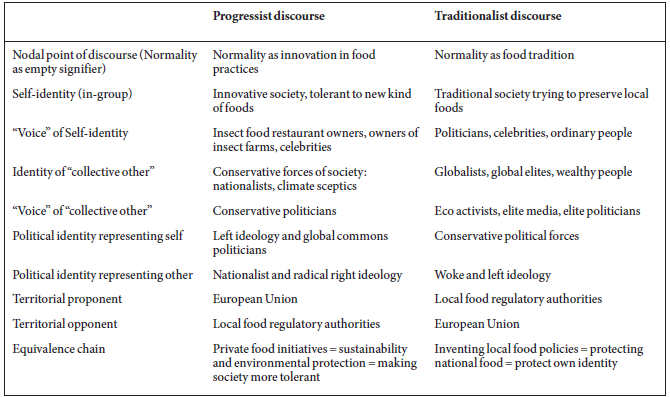
Both discourses are built mutually in relationship between them. What is considered as “self-group” in the progressist one will be depicted as “out-group” in other and respectively. The table 2 summarizes such controversial positions in two discourses (Table 2).
Table
2.
Core elements of antagonist discourses
Source: Prepared by the author.
The key nodal point in both discourses is “normality” which represents an “empty signifier” articulated in a different manner. This notion of “normality” in progressive discourse is discursively articulated through efforts to normalize the consumption of edible insects as food. In contrast, in traditionalist discourse it has sense of “protecting food traditions”.
In the progressive discourse, the in-group constructs itself as an innovative, open, and tolerant society willing to embrace novel foods. The voices articulating this discourse are predominantly those of insect-based restaurant and farm owners, industry representatives, experts, and celebrities, who contribute to the normalization of entomophagy. By contrast, in the traditionalist discourse, the in-group identity is that of a traditional society, articulated primarily through the voices of politicians, certain celebrities, and ordinary citizens. This contrast is particularly evident in the fact that the traditionalist discourse mobilizes “the people’s voice” —for example, street protests or public reactions— whereas the progressive discourse often highlights industry representatives and experts.
The “collective other” is also constructed differently in antagonistic discourses. In the progressive discourse, the “other” consists of conservative forces and climate-change sceptics, typically represented by conservative politicians whose statements are frequently cited. Conversely, in the traditionalist discourse, the “other” is defined as globalists, wealthy elites, and eco-activists, often caricatured as “elite politicians and media figures eating lobsters in luxury restaurants”.
Ideologically, the progressive discourse is anchored in a left-leaning ethic of the commons, prioritizing collective objectives —most notably environmental sustainability— over individual preferences. This orientation stands in sharp contrast to the traditionalist discourse, which is rooted in right-wing or far-right political traditions, emphasizing nationalism, cultural traditionalism, and opposition to what is labeled “woke” ideology.
Territorially, the progressive discourse is strongly associated with the EU, often portrayed as the principal advocate of entomophagy. Traditionalist discourse, however, depicts the EU as an external adversary seeking to undermine national food traditions. Conversely, in the progressive discourse, local food regulatory authorities are sometimes framed as obstacles for being insufficiently proactive in introducing edible insects. In the traditionalist one, these same authorities are often presented as “protectors” of national culinary heritage.
The progressive discourse tends to construct an “equivalence chain” linking private food initiatives, sustainability, environmental protection, and the broader goal of building a more tolerant society by opposing conservative forces. The traditionalist discourse, in turn, builds its own chain of equivalences, associating local food policies with the defence of national traditions, opposition to globalist ideology, and the preservation of cultural identity.
Initially we expected particular polarization of different media outlets around different kind of discourse. But after the research we must say that antagonistic discourses are clearly politicized, and their presence is not strictly determined by the type of media outlet. Tabloids and popular media, for example, may advance either discourse. On the one hand, they might publish entertaining stories —such as Nicholas Cage reportedly eating insects during the filming of Dracula— which contribute to the progressive narrative. On the other hand, the same outlets may run alarmist stories about school programs “sensitizing” pupils to entomophagy, which align with the traditionalist perspective. The strongest ideological determinism is present only in case of partisan media (as Breitbart) and media which are considered as being controlled by the government (as in Hungary where Magyar Nemzet is controlled by the ruling party Fidesz).
The differences between countries should also be taken under consideration. In several countries, entomophagy does not constitute a salient issue within the political field. As a result, in Brazilian, Swedish, Australian, and even UK —and to some extent US— media, the topic is often treated in a relatively neutral manner, presenting both advantages and disadvantages of insect consumption. Although both antagonistic discourses may be present, their level of politicization remains limited, as political parties and their rhetoric do not mobilize entomophagy as a central issue of ideological struggle. Consequently, in these contexts, entomophagy does not function as a significant mechanism of “othering” or polarization. By contrast, in Germany, Italy, Poland and Hungary, the politicization of entomophagy is markedly stronger, as “eating insects” is mobilized as a symbolic marker of political identity. As a result, in such countries media either critically reacts on political rhetorics of “traditionalist” political forces (which produces a progressist discourse) or shares the public and popular concerns about “destructing traditional food” (which creates a traditionalist one). In all of these cases, far-right populist actors play a central role, actively incorporating entomophagy into their populist rhetoric as a means of mobilizing identity-based antagonisms.
REFERENCES
Allcott, H., Boxell, L., Conway, J., Gentzkow, M., Thaler, M. & Yang, D. (2020). Polarization and Public Health: Partisan Differences in Social Distancing during the Coronavirus Pandemic. Journal of Public Economics, 191. https://doi.org/10.1016/j.jpubeco.2020.104254
Altheide, D., Snow, R. (1979). Media Logic. Sage.
Baysha, O. (2022). Democracy, Populism, and Neoliberalism in Ukraine. Routledge.
Bennett, L. & Livingston, S. (2020). The Coordinated Attack on Authoritative Institutions: Defending Democracy in the Disinformation Age. In Bennett, L. & Livingston, S. (eds.), The Disinformation Age. Politics, Technology, and Disruptive Communication in the United States (pp. 261-294). Cambridge University Press.
Bennett, W. L. & Livingston, S. (2018). The disinformation order: Disruptive communication and the decline of democratic institutions. European Journal of Communication, 33(2), 122-139. https://doi.org/10.1177/0267323118760317
Bliss, C. (2013). The Marketization of Identity Politics. Sociology, 47(5), 1011-1025. https://doi.org/10.1177/0038038513495604
Bobba, G., Mancosu, M., Nai, A., Seddone, A. & Vegetti, F. (2025). Investigating Media Populism Worldwide. Journalism Studies, 26(2), 181-199. https://doi.org/10.1080/1461670X.2024.2415423
Bordenca, I. V. (2025). Eating Insects and Italian Gastronomy. E|C, (43), 145-160. https://mimesisjournals.com/ojs/index.php/ec/article/view/5276
Carrié, F. (2018). Politicizing Activist Discontent, Biens Symboliques / Symbolic Goods, 2. https://doi.org/10.4000/bssg.249
Crouch, C. (2004). Post-democracy. Polity.
De Oliveira, J.-P. & Clavier, V. (2025). Alimentation et santé : construction d’un problème public et enjeux info-communicationnels. Sciences de la société, 108. https://doi.org/10.4000/137i8
DeYoung, S. E. & Farmer, A. K. (2023). Politicization of COVID-19 and Conspiratorial Beliefs Among Emergency & Public Health Officials. Journal of Homeland Security and Emergency Management, 20(3), 385-403. https://doi.org/10.1515/jhsem-2021-0072
EFSA Scientific Committee (2015). Scientific Opinion on a risk profile related to production and consumption of insects as food and feed, EFSA Journal, 13(10). https://doi:10.2903/j.efsa.2015.4257
Farkas, J. & Schou, J. (2020). Post-truth, Fake News and Democracy. Mapping the Politics of Falsehood. Routledge.
Fischler, C. (1988). Food, self and identity. Social Science Information, 27(2), 275-292.
Gentzkow, M. & Shapiro, J. (2011). Ideological Segregation Online and Offline. The Quarterly Journal of Economics, 126(4), 1799-1839. https://doi:10.1093/qje/qjr044
Giry, J. (2023). Panic(s) in Our Plates: Contemporary Legends and Conspiracy Theories on Food, Contemporary Legend 1, 1-24. https://scholarworks.iu.edu/journals/index.php/cl/article/view/37090.
Henchion M., Hayes M., Mullen A.M., Fenelon M. & Tiwari B. (2017). Future Protein Supply and Demand: Strategies and Factors Influencing a Sustainable Equilibrium, Foods, 6(53). https://doi:10.3390/foods6070053
Hjarvard, S. (2013). The Mediatization of Culture and Society. Routledge.
Jørgensen, M. & Phillips, L. (2002). Discourse Analysis as Theory and Method. Sage.
Laclau, E. (2005). On populist reason. Verso.
Laclau, E. & Mouffe, C. (1985). Hegemony and socialist strategy: Towards a radical democratic politics. Verso.
Maly, I. (2018). Populism as a mediatized communicative relation: The birth of algorithmic populism. Tilburg Papers in Culture Studies, 213. https://www.tilburguniversity.edu/sites/tiu/files/download/TPCS_213_Maly_2.pdf
Mancini S., Sogari G., Espinosa Diaz S., Menozzi D., Paci G. & Moruzzo R. (2022). Exploring the Future of Edible Insects in Europe. Foods, 11(3). https://doi.org/10.3390/foods11030455
Mariani, L., Gagete-Miranda, J. & Retti, P. (2020). Words can hurt: How political communication can change the pace of an epidemic. OSF Preprints ps2wx, Center for Open Science. https://ideas.repec.org/p/osf/osfxxx/ps2wx.html
Medek D.E., Schwartz J. & Myers S.S. (2017). Estimated Effects of Future Atmospheric CO2 Concentrations on Protein Intake and the Risk of Protein Deficiency by Country and Region. Environ. Health Perspect, 125. https://pubmed.ncbi.nlm.nih.gov/28885977/
Müller, J-W. (2016). What Is Populism? University of Pennsylvania Press. https://doi.org/10.9783/9780812293784
Parasecoli, F. (2022). Gastronativism. Food, Identity, Politics. Columbia University Press.
Parés i Maicas, M. (1996). An Approach to Cultural Identity and its Connections with Mass Communication. Scottish Affairs, 17(1), 98-111. https://doi.org/10.3366/scot.1996.0057
Pariser, E. (2012). The Filter Bubble: How the New Personalized Web Is Changing What We Read and How We Think. Penguin Books.
van Dijck, J. (2013). The culture of connectivity. A critical history of social media. Oxford University Press.
Wang, Y.-S. & Shelomi, M. (2017). Review of Black Soldier Fly (Hermetia illucens) as Animal Feed and Human Food. Foods, 6(10). https://doi.org/10.3390/foods6100091
*
Author contribution: The
sole author was responsible for the conception of the work, research
design, data collection, data processing and analysis, document
preparation, and correction.
* Note: the Academic Committee of the journal approved the publication of the article.
* The dataset that supports the results of this study is not available for public use. The research data will be made available to reviewers, if required.

Article published in open access under the Creative Commons License - Attribution 4.0 International (CC BY 4.0).
AUTHOR
IDENTIFICATION
Ilya Kiriya. Ph.D. in Information and Communication Sciences from Université Stendhal Grenoble III (France). Ph.D. in Journalism Studies from Lomonosov Moscow State University (Russia). Professor of Information and Communication Sciences at Université Grenoble Alpes (France). He earned his undergraduate degree in Journalism from Moscow State University and completed a research master’s degree at Université Stendhal Grenoble. He is the author of more than 90 academic articles published in journals such as International Journal of Communication, Journalism studies, Media and Communications, Russian Journal of Communication. He has coordinated numerous special issues and edited volumes, and has authored several monographs published in Russia, where he spent the first part of his academic career as Professor and Chair of the School of Media at HSE University (Russia). His current research focuses on the fragmentation of the public sphere in the post-Soviet space, digital sovereignty, and cultural industries in countries with hybrid political regimes. He is a member of the editorial boards of the French academic journal Hermès and Global Media and Communication.
i This article was conducted within the framework and support of the Cross Disciplinary Program (CDP) PUNAISES, Université Grenoble Alpes, France.
ii https://www.theguardian.com/environment/2020/apr/03/insects-likely-approved-human-consumption-by-eu
iii https://www.theguardian.com/food/2021/feb/01/grubs-up-mealworms-are-on-the-menu-but-are-we-ready-for-them
v https://www.theguardian.com/environment/2020/apr/03/insects-likely-approved-human-consumption-by-eu
viiihttps://www.corriere.it/cook/news/23_marzo_24/avranno-scaffali-dedicati-farine-d-insetti-la-richiesta-potrebbe-essere-illegittima-009b431e-c986-11ed-9401-3e478e5d4ed3.shtml
ix https://www.theguardian.com/food/2021/feb/01/grubs-up-mealworms-are-on-the-menu-but-are-we-ready-for-them
xhttps://www.theguardian.com/environment/2022/oct/02/cordon-bleugh-worms-and-crickets-could-soon-be-tickling-french-palates
xi https://www.dn.se/kultur/maria-gunther-inspirerande-att-hora-elin-roos-tala-om-maten-och-klimatet/
xiihttps://www.smh.com.au/lifestyle/life-and-relationships/i-was-excited-by-the-buzz-around-eating-insects-until-i-tried-one-20210819-p58k84.html
xiii https://www.aftonbladet.se/svenskahjaltar/a/eKlK9K/nils-odlar-maskar-som-ska-bli-mat--har-notaktig-smak -
xivhttps://www.corriere.it/cook/news/21_gennaio_13/primo-ok-dell-efsa-vermi-farina-essiccati-come-alimento-b2d94bd6-55a5-11eb-a877-0f4e7aa8047a.shtml
xvi https://bergamo.corriere.it/notizie/cronaca/23_marzo_18/insetti-come-cibo-crescono-i-favorevoli-l-indagine-dell-universita-di-bergamo-73701ffc-8f85-43be-b5ec-1105594d1xlk.shtml
xviihttps://www.smh.com.au/national/queensland/avocado-and-ants-on-toast-chef-says-buzz-is-building-around-edible-insects-20231009-p5eavw.html
xixhttps://wroclaw.wyborcza.pl/wroclaw/7,35771,29401491,hejt-na-kawiarnie-z-wroclawia-ktora-serwuje-deser-z.html
xxhttps://www.se.pl/wiadomosci/lekkie/krzysztof-bosak-ma-gigantyczny-problem-z-robakami-dreczyl-go-caly-weekend-aa-KDgu-sjVe-xnxt.html
xxiihttps://www.breitbart.com/europe/2021/06/30/delingpole-meet-the-new-health-secretary-same-as-the-old-health-secretary/
xxiv https://www.couriermail.com.au/news/national/disgusting-aldi-uk-considers-selling-edible-insects-amid-cost-of-living-crisis/video/869318451e0873d5a48db9baf6d46028
xxvhttps://www.breitbart.com/europe/2022/05/31/eat-the-bugs-welsh-schoolchildren-fed-insects-encourage-sustainability/
xxvihttps://www.smh.com.au/environment/climate-change/you-re-gonna-eat-bugs-climate-fears-and-conspiracies-at-canberra-renewables-protest-20240208-p5f3e8.html
xxviiihttps://www.breitbart.com/europe/2022/05/31/eat-the-bugs-welsh-schoolchildren-fed-insects-encourage-sustainability/
xxixhttps://poznan.wyborcza.pl/poznan/7,36001,29491152,przedszkolaki-z-misia-uszatka-sprobowaly-jak-smakuja-robaki.html
xxx https://www.nytimes.com/2022/09/19/business/media/russia-war-food-supply-chain-disinformation.html
xxxi https://www.couriermail.com.au/news/national/insects-algae-and-bacteria-wa-labor-mps-push-aussies-to-give-up-red-meat/video/d9a3e1374cfa510b1f66c18aa644f8ff
xxxii https://www.liberoquotidiano.it/news/piulibero/34855544/farina-grillo-evitarla-leggere-bene-etichetta.html
xxxiii https://www.couriermail.com.au/news/national/disgusting-aldi-uk-considers-selling-edible-insects-amid-cost-of-living-crisis/video/869318451e0873d5a48db9baf6d46028
xxxiv https://www.se.pl/wiadomosci/lekkie/nie-beda-nas-karmic-robalami-polacy-w-strachu-oni-jedza-steki-nam-daja-robaki-komentery-aa-zDuk-wv9F-ynBV.html
xxxv https://www.liberoquotidiano.it/articolo_blog/blog/andrea-cionci/34899124/ue-via-libera-verme-farina-speculano-grano-andato-male.html
xxxvii https://www.breitbart.com/europe/2023/05/03/great-reset-companies-try-train-children-to-eat-bugs-in-switzerland/
xxxviii https://www.estadao.com.br/politica/gestao-politica-e-sociedade/farinha-de-grilo-nao-obrigado/
xxxix https://www.liberoquotidiano.it/news/politica/31921294/beppe-grillo-vuole-far-mangiare-grilli-larve-piccolini-ecco-perche-follia.html
xlii https://www.breitbart.com/europe/2021/01/13/eat-the-bugs-eu-approves-mealworms-for-human-consumption/
xlvhttps://index.hu/gazdasag/2023/03/24/szabalyozas-rovarfeherjek-elelmiszerek-termekjeloles-agrarminiszter-jelolesi-rendelet/
xlviii https://www.liberoquotidiano.it/news/europa/34639007/vino-stretta-consumo-ultima-follia-ue.html