
El Papel de la Tecnología de Hogares Inteligentes en la Configuración de las Preferencias de Vivienda de los Zillennials en el Área Metropolitana de Yakarta, Indonesia
DOI:
https://doi.org/10.18861/ania.2025.15.2.4054Palabras clave:
tecnología de hogares inteligentes, Generación zillenial, tendencias de vivienda urbana, países en desarrollo, tendencias arquitectónicas, Área Metropolitana de Yakarta (JMA)Resumen
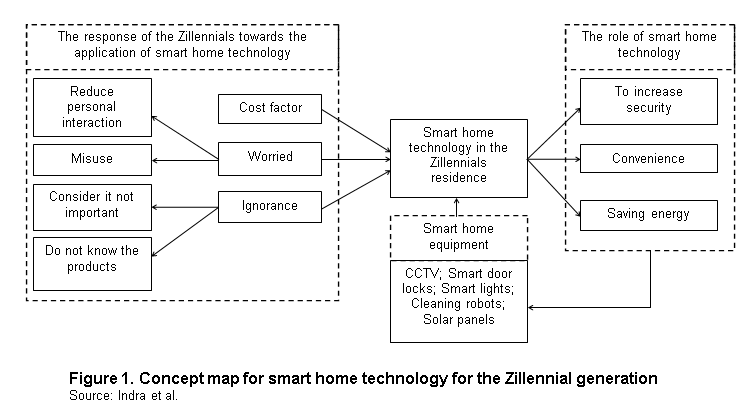
Este estudio investiga la adopción de tecnologías de hogares inteligentes entre la generación Zillennial en el Área Metropolitana de Yakarta (JMA), la mayor aglomeración urbana de Indonesia y una de las más densamente pobladas del mundo. Representando el 24,3% de la población nacional, los Zillennials emergen como un grupo demográfico clave en el mercado de la vivienda, caracterizado por su dependencia tecnológica y expectativas de estilo de vida en evolución. La investigación utilizó un método de encuesta y aplicó una versión extendida del Modelo de Aceptación de Tecnología (TAM) y la Teoría Unificada de Aceptación y Uso de Tecnología (UTAUT), desarrollados por Mashal et al. (2020–2023), para explorar las influencias sociodemográficas en las percepciones sobre hogares inteligentes. Los hallazgos revelan tres ideas clave: alta conciencia del mercado en todos los niveles de ingresos; el tamaño del hogar como factor moderador; y una adopción más fuerte en ambos extremos del espectro residencial, tanto en viviendas compactas como en hogares amplios. A pesar del creciente cuerpo de investigación sobre tecnologías de hogares inteligentes, se ha prestado poca atención al grupo Zillennial. Teóricamente, este estudio contribuye al contextualizar TAM y UTAUT dentro de la dinámica sociocultural de los Zillennials en un contexto urbano en desarrollo. Prácticamente, ofrece recomendaciones basadas en evidencia para diseñar soluciones de hogares inteligentes inclusivas y sensibles al perfil demográfico en áreas de rápida urbanización como JMA.
Descargas
Citas
Alam, M.R., Reaz, M.B.I., Ali, M.A.M. (2012). A Review of Smart Homes—Past, Present, and Future. IEEE Transactions on Systems, Man, and Cybernetics, Part C (Applications and Reviews) 42, 1190–1203. https://doi.org/10.1109/TSMCC.2012.2189204.
Annur, C.M. (2023, October 17). Penduduk Indonesia Tembus 278 Juta Jiwa hingga Pertengahan 2023 [Indonesia's population will reach 278 million by mid-2023]. Retrieved from https://databoks.katadata.co.id/datapublish/2023/07/13/penduduk-indonesia-tembus-278-juta-jiwa-hingga-pertengahan-2023.
Baillie, L., & Benyon, D. (2008). Place and Technology in the Home. Computer Supported Cooperative Work (CSCW) 17, 227–256. https://doi.org/10.1007/s10606-007-9063-2.
Bassiouni, D.H., & Hackley, C. (2014). Generation Z children’s adaptation to digital consumer culture: A critical literature review. Journal of Customer Behaviour 13, 113–133. https://doi.org/10.1362/147539214X14024779483591.
Bijolia, D. (2022, October 11). Diary Of A Zillennial: What It’s Like Being A Middle Child Of A Generational Divide. Retrieved from https://homegrown.co.in/homegrown-creators/diary-of-a-zillenial-what-its-like-being-a-middle-child-of-a-generational-divide.
Bitterman, N., & Shach-Pinsly, D. (2015). Smart home – a challenge for architects and designers. Architectural Science Review 58, 266–274. https://doi.org/10.1080/00038628.2015.1034649.
BPS. (2023). Jumlah Penduduk Usia 15 tahun ke Atas Menurut Golongan Umur 2021-2022 [Number of Population Aged 15 Years and Over According to Age Group 2021-2022]. Badan Pusat Statistik [Central Bureau of Statistics of the Republic of Indonesia]. Retrieved from https://www.bps.go.id/indicator/6/715/1/jumlah-penduduk-usia-15-tahun-ke-atas-menurut-golongan-umur.html.
Choi, J., Lee, H.J., Sajjad, F., Lee, H. (2014). The influence of national culture on the attitude towards mobile recommender systems. Technological Forecasting and Social Change 86, 65–79. https://doi.org/10.1016/j.techfore.2013.08.012.
De Ruyck, O., Conradie, P., De Marez, L., Saldien, J. (2019). User Needs in Smart Homes: Changing Needs According to Life Cycles and the Impact on Designing Smart Home Solutions. In Lamas, D., Loizides, F., Nacke, L., Petrie, H., Winckler, M., Zaphiris, P. (Eds.), Human-Computer Interaction – INTERACT 2019, Lecture Notes in Computer Science (pp. 536–551). Cham: Springer International Publishing. https://doi.org/10.1007/978-3-030-29384-0_33.
Diaz, A. (2023, May 10). Who are ‘zillennials’? Meet the microgeneration between millennials and Gen Z. Retrieved from https://nypost.com/2023/05/10/who-are-zillennials-meet-the-microgeneration-between-millennials-and-gen-z/.
Fields, J. (2021). A View of the Future from the Broad Top: Reaching, Connecting, and Engaging with Zillennials in Rural Pennsylvania. (Doctoral dissertation, George Fox University, Portland, USA).
Gaikwad, P.P., Gabhane, J.P., Golait, S.S. (2015). A survey based on Smart Homes system using Internet-of-Things. International Conference on Computation of Power, Energy, Information and Communication (ICCPEIC). Melmaruvathur, Chennai, India, pp. 0330–0335. https://doi.org/10.1109/ICCPEIC.2015.7259486.
Governor of the Special Capital Region of Jakarta Decree No. 829 of 2024 concerning the Provincial Minimum Wage for the Year 2025 Retrieved from https://jdih.jakarta.go.id/dokumen/detail/14171.
Hargreaves, T., Wilson, C., Hauxwell-Baldwin, R. (2018). Learning to live in a smart home. Building Research & Information 46, 127–139. https://doi.org/10.1080/09613218.2017.1286882.
Hartmans, A. (2023, January 18). Meet the 'zillennials,' who grew up online, live with their parents, and have retailers chasing their disposable income. Retrieved from https://www.businessinsider.com/zillennial-lives-with-parents-spends-on-luxury-goods-2023-1.
Hofman, E., Halman, J.I.M., Ion, R.A. (2006). Variation in Housing Design: Identifying Customer Preferences. Housing Studies 21, 929–943. https://doi.org/10.1080/02673030600917842.
Israel, G.D. (1992). Determining Sample Size. University of Florida, Fact Sheed PEOD-6.
Jannah, N., & Muliatie, Y.E. (2023). How To Green Product And Ethical Living For Zillenial Generation Ladynability In Surabaya City ?. International Journal of Global Accounting, Management, Education, and Entrepreneurship 4, 129–134. https://doi.org/10.48024/ijgame2.v4i1.111.
Kaufman, A. (2023, May 18). Move over Millennials and Gen Z, there's a new generation in town: Meet Zillennials. Retrieved from https://www.usatoday.com/story/news/2023/05/18/is-zillennial-a-real-thing/70207436007/.
Kolb, E. (2019, July 11). 75,000 people per square mile? These are the most densely populated cities in the world. Retrieved from https://www.usatoday.com/picture-gallery/news/world/2019/07/11/the-50-most-densely-populated-cities-in-the-world/39664445/.
Kolny, B. (2023). Young Consumers Towards an Ecological Approach to Life in the Age of Smart Homes and Devices. Marketing of Scientific and Research Organizations 47, 105–126. https://doi.org/10.2478/minib-2023-0006.
Lee, L.N., & Kim, M.J. (2020). A Critical Review of Smart Residential Environments for Older Adults With a Focus on Pleasurable Experience. Frontiers in Psychology 10, 3080. https://doi.org/10.3389/fpsyg.2019.03080.
Magalhaes, M. (2023). Did We Forget An Entire Audience? The Zillennials. Retrieved from https://forty8creates.com/did-we-forget-an-entire-audience-the-zillennials/.
Mashal, I., Shuhaiber, A., Daoud, M., 2020. Factors influencing the acceptance of smart homes in Jordan. International Journal Electronic Marketing and Retailing 11, 113–142.
Mashal, I., Shuhaiber, A., AL-Khatib, A.W., 2023. User acceptance and adoption of smart homes: A decade long systematic literature review. 10.5267/j.ijdns 7, 533–552. https://doi.org/10.5267/j.ijdns.2023.3.017
Melcher, K. (2021, July 21). Opendoor 2021 report: Achieving the American dream. Retrieved from https://www.opendoor.com/articles/achieving-the-american-dream.
Nakagawa, K., & Yellowlees, P. (2020). Inter-generational Effects of Technology: Why Millennial Physicians May Be Less at Risk for Burnout Than Baby Boomers. Current Psychiatry Reports 22, 45. https://doi.org/10.1007/s11920-020-01171-2.
Owens, B. (2022, November 16). Who are the Zillennials? (And why should brands care?). Retrieved from https://whiplash.com/blog/who-are-zillenials/.
Rawat, D., & Rawat, K. (2023). A Study of Zillennials in Uttarakhand Using RStudio, Journal of Graphic Era University. https://doi.org/10.13052/jgeu0975-1416.1021.
SECOM (2023, May 1). Smart Home Makin Diminati, Tapi Penuh Tantangan [Smart Homes Are Increasingly Popular, But Full of Challenges]. Retrieved from https://secom.co.id/id/smart-home-makin-diminati-tapi-penuh-tantangan/.
Singh, A.S., & Masuku, M.B. (2014). Sampling Techniques & Determination Of Sample Size In Applied Statistics Research: An Overview. International Journal of Economics, Commerce and Management 2-11.
Stromberg, N. (2020). Gen Y needs places to stay, prefers smart homes. Retrieved from https://sensative.com/gen-y-need-places-to-stay-smart-home/.
Strzalka, K.B. (2019). What are the students’ housing preferences? A case study of Lublin, Poland. Stockholm, Sweden. Kth Royal Institute Of Technology School Of Architecture And The Built Environment. Degree Project, Second Cycle, 30 Credits.
Suresh, T. (2022). The Zillennial Generation and the Modern Workplace: Enabling the Right Culture Fit. SIBM Pune Research Journal XXV, 63–64. https://doi.org/10.53739/samvad/2022/v25/172597.
The World Bank. (2023). The World Bank in Indonesia. Retrieved from: https://www.worldbank.org/en/country/indonesia/overview
Twenge, J.M. (2023). Generations. (3rd ed.). New York: Atria Books.
Wahyudi, H. (2023, August 1). Gen Z Indonesia: Budaya Pop, Metroseksual, dan Masa Depan Identitas Kebangsaan [Gen Z Indonesia: Pop Culture, Metrosexuals, and the Future of National Identity]. Retrieved from https://kumparan.com/s-heru/gen-z-indonesia-budaya-pop-metroseksual-dan-masa-depan-identitas-kebangsaan-20uEteDOMUF/3.
Widi, H. (2023, December 12). Biaya Hidup Naik, Rp 14,88 Juta Per Bulan di Jakarta [Cost of Living Rises to Rp 14.88 Million Per Month in Jakarta]. Retrieved from https://www.kompas.id/artikel/en-dalam-empat-tahun-terakhir-biaya-hidup-naik-rp-1-juta-rp-15-juta.
White Hutchinson (February, 2023). Zillennials and their disposable income. White Hutchinson Vol. XXIII no. 2. Retrieved from https://www.whitehutchinson.com/news/lenews/2023/february/article104.shtml
Wilson, C., Hargreaves, T., Hauxwell-Baldwin, R. (2017). Benefits and risks of smart home technologies. Energy Policy 103, 72–83. https://doi.org/10.1016/j.enpol.2016.12.047.
Yang, H., Lee, W., Lee, H. (2018). IoT Smart Home Adoption: The Importance of Proper Level Automation. Journal of Sensors 2018, 1–11. https://doi.org/10.1155/2018/6464036.
Zerr-Korolev, M. (2022). Recruiting the New Generations: Gen Z and “Zillennials”. Retrieved from https://cssienroll.com/blog/Recruiting-GenZ_and_Zillennials.html.
Descargas
Publicado
Cómo citar
Número
Sección
Licencia
Derechos de autor 2025 Mewan Indra, Arif Kusumawanto, Agus Hariyadi

Esta obra está bajo una licencia internacional Creative Commons Atribución 4.0.
El contenido de los artículos publicados es responsabilidad exclusiva de sus autores y no reflejan necesariamente las opiniones del Comité Editorial, ni de los evaluadores.
La revista Anales de Investigación en Arquitectura preserva los derechos de los autores, que son adoptados por Comité Editorial para su publicación. Los autores declaran que el trabajo presentado es inédito y no ha sido publicado en una revista científica o en una monografía.
La revista Anales de Investigación en Arquitectura proporciona un acceso abierto a sus contenidos, basados en el principio de la licencia internacional Creative Commons Reconocimiento 4.0 International License, que ofrece al público un acceso libre a las investigaciones para ayudar a un mayor intercambio global del conocimiento.