
Hacia un futuro sostenible
Evaluación presente y futura de políticas energéticas para envolventes residenciales en México
DOI:
https://doi.org/10.18861/ania.2025.15.2.4159Palabras clave:
Mitigación al cambio climático, países en desarrollo, prospectivas energéticas, política habitacional, vivienda socialResumen
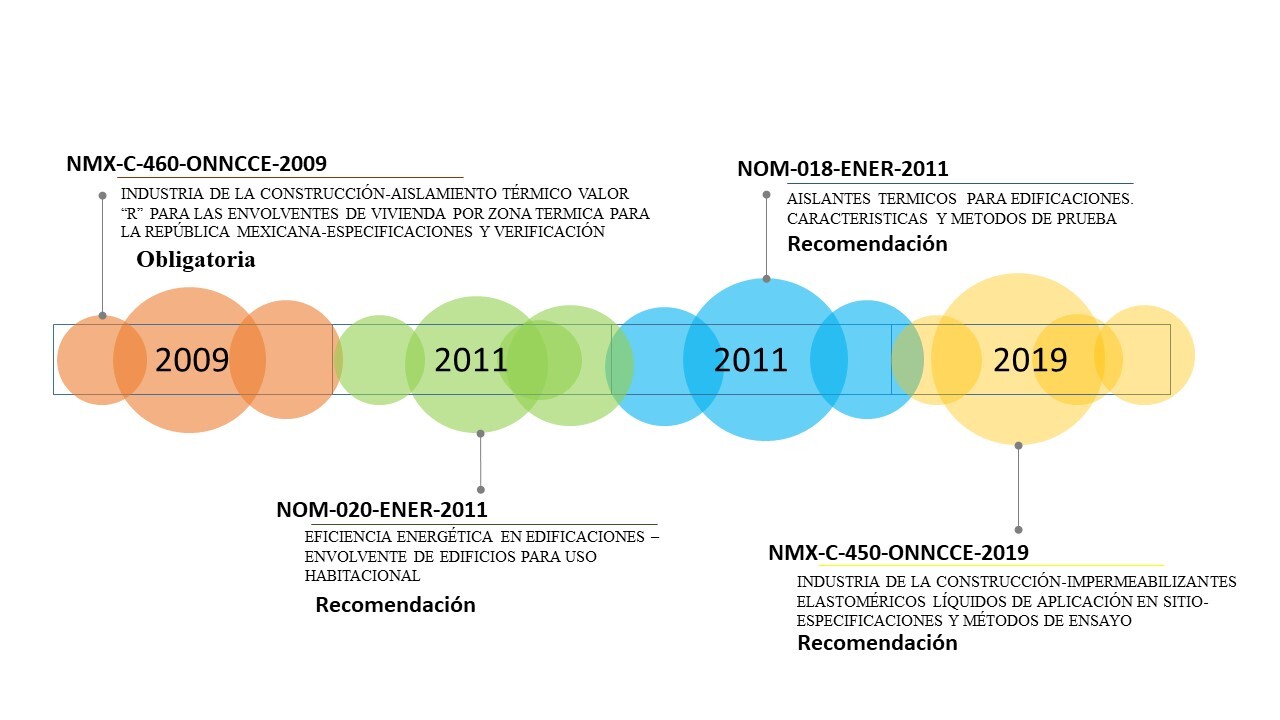
Los países latinoamericanos implementan regulaciones para mejorar la eficiencia energética en viviendas frente al cambio climático. El objetivo de este estudio fue evaluar el desempeño térmico y las políticas obligatorias para la eficiencia energética en edificaciones en México a lo largo del siglo XXI. Este estudio desarrolló una metodología con indicadores de mitigación del cambio climático y confort térmico, aplicados a viviendas de interés social. Se realizó un análisis numérico considerando dos escenarios de mejora de la envolvente y sus proyecciones para 2024, 2050 y 2100. Los resultados indican una reducción cercana a 4 °C en la temperatura operativa al mejorar la envolvente en comparación con el caso de referencia. La metodología propuesta representa una herramienta para evaluar políticas energéticas y anticipar su efectividad a corto, medio y largo plazo, facilitando el diseño de viviendas nuevas y usadas, así como la implementación de estrategias para un futuro sostenible y equitativo.
Descargas
Citas
Alford-Jones, K. (2022). How injustice can lead to energy policy failure: A case study from Guatemala. Energy Policy, 164(March), 112849. https://doi.org/10.1016/j.enpol.2022.112849
Alhazmi, M., Sailor, D. J., & Anand, J. (2022). A new perspective for understanding actual anthropogenic heat emissions from buildings. Energy and Buildings, 258, 111860. https://doi.org/10.1016/j.enbuild.2022.111860
Ali, M. H., & Abustan, I. (2014). A new novel index for evaluating model performance. Journal of Natural Resources and Development, 2002, 1–9. https://doi.org/10.5027/jnrd.v4i0.01
Alpuche Cruz, M. G., & Duarte Aguílar, E. A. (2017). La NOM-020-ENER-2011 en viviendas económicas ubicadas en diferentes regiones climáticas de México. Vivienda y Comunidades Sustentables, 1(1), 75–90. https://doi.org/10.32870/rvcs.v0i1.6
American Society of Heating, Refrigerating and Air-Conditioning Engineers, Inc. (2021). ASHRAE Standard 55-2020. In ASHRAE (Vol. 2, Issue 1). https://doi.org/10.1016/0140-7007(79)90114-2
Andrew, K., Majerbi, B., & Rhodes, E. (2022). Slouching or speeding toward net zero? Evidence from COVID-19 energy-related stimulus policies in the G20. Ecological Economics, 201(August), 107586. https://doi.org/10.1016/j.ecolecon.2022.107586
ASHRAE. (2018). ANSI/ ASHRAE/ IES Standard 100-2018: Energy Efficiency in Existing Buildings. 2018, 14.
Bai, H., Gao, W., Zhang, Y., & Wang, L. (2022). Assessment of health benefit of PM2.5 reduction during COVID-19 lockdown in China and separating contributions from anthropogenic emissions and meteorology. Journal of Environmental Sciences (China), 115, 422–431. https://doi.org/10.1016/j.jes.2021.01.022
Belaïd, F. (2022). Implications of poorly designed climate policy on energy poverty: Global reflections on the current surge in energy prices. Energy Research and Social Science, 92(August), 102790. https://doi.org/10.1016/j.erss.2022.102790
Belaïd, F., & Flambard, V. (2023). Impacts of income poverty and high housing costs on fuel poverty in Egypt: An empirical modeling approach. Energy Policy, 175(January). https://doi.org/10.1016/j.enpol.2023.113450
Bodach, S., & Hamhaber, J. (2010). Energy efficiency in social housing: Opportunities and barriers from a case study in Brazil. Energy Policy, 38(12), 7898–7910. https://doi.org/10.1016/j.enpol.2010.09.009
Cadaval, M., Regueiro-Ferreira, R. M., & Calvo, S. (2022). The role of the public sector in the mitigation of fuel poverty in Spain (2008–2019): Modeling the contribution of the Bono Social de Electricidad. Energy, 258, 124717. https://doi.org/10.1016/j.energy.2022.124717
Cengel, Y. A., & Ghajar, A. J. (2015). Heat and Mass Transfer. Fundamentals and applications (Mc Graw Hill Education, Ed.; Fifth Edit).
Chévez, P. J., Ruggeri, E., Martini, I., & Discoli, C. (2019). Factores Clave En La Implementación De Políticas Energéticas En Italia. Revista Produção e Desenvolvimento, 5, 1–21. https://doi.org/10.32358/rpd.2019.v5.384
Diario Oficial de la Federación. (2009). NMX-C-460-ONNCCE-2009 BUILDING INDUSTRY – INSULATION – “R” VALUE FOR THE HOUSING ENVELOPE BY THERMAL ZONE FOR MEXICAN REPUBLIC – SPECIFICATION AND VERIFICATION.
Diario Oficial de la Federación. (2011). Mexican Official Standard NOM-020-ENER-2011. http://dof.gob.mx/nota_detalle.php?codigo=5203931&fecha=09/08/2011
Encuesta Nacional de Vivienda. (2021). Comunicado de Prensa. Encuesta Nacional de vivienda (ENVI), 2020 . Principales resultados. In Comunicado de Prensa 493/21 (Vol. 1).
Escandón, R., Suárez, R., & Sendra, J. J. (2019). Field assessment of thermal comfort conditions and energy performance of social housing : The case of hot summers in the Mediterranean climate. Energy Policy, 128(July 2018), 377–392. https://doi.org/10.1016/j.enpol.2019.01.009
European Committee for Standardization. (2001). ISO 7726 Ergonomics of the thermal environment — Instruments for measuring physical quantities. In Iso 7726:2001 (Issue 1).
Fabbri, Kristian, Gaspari, J. (2021). Mapping the energy poverty: A case study based on the energy performance certificates in the city of Bologna. Energy and Buildings. https://doi.org/10.1016/j.enbuild.2021.110718
Gatto, A. (2022). The energy futures we want: A research and policy agenda for energy transitions. Energy Research and Social Science, 89(March), 102639. https://doi.org/10.1016/j.erss.2022.102639
Griego, D., Krarti, M., & Hernández-Guerrero, A. (2012). Optimization of energy efficiency and thermal comfort measures for residential buildings in Salamanca, Mexico. Energy and Buildings, 54, 540–549. https://doi.org/10.1016/j.enbuild.2012.02.019
Hewitt, R. J., Cremades, R., Kovalevsky, D. V., & Hasselmann, K. (2021). Beyond shared socioeconomic pathways (SSPs) and representative concentration pathways (RCPs): climate policy implementation scenarios for Europe, the US and China. Climate Policy, 21(4), 434–454. https://doi.org/10.1080/14693062.2020.1852068
INEGI. (2020). Marco Geoestadístico Municipal. Sistema de Clasificación Climática de Köppen (1936) Modificado Por Enriqueta García (1973) e INEGI (1976). http://cuentame.inegi.org.mx/mapas/pdf/nacional/tematicos/climas.pdf
INEGI; Instituto Nacional de Estadística y Geografía. (2022). Inventario Nacional de Vivienda. https://www.inegi.org.mx/temas/vivienda/
INEGI, Instituto Nacional de Geografía, E. e I. (2023). Population. Population. https://cuentame.inegi.org.mx/poblacion/habitantes.aspx?tema=P
Jiglau, G., Bouzarovski, S., Dubois, U., Feenstra, M., Gouveia, J. P., Grossmann, K., Guyet, R., Herrero, S. T., Hesselman, M., Robic, S., Sareen, S., Sinea, A., & Thomson, H. (2023). Looking back to look forward: Reflections from networked research on energy poverty. IScience, 26(3), 1–22. https://doi.org/10.1016/j.isci.2023.106083
Jonek-Kowalska, I. (2022). Multi-criteria evaluation of the effectiveness of energy policy in Central and Eastern European countries in a long-term perspective. Energy Strategy Reviews, 44(May), 100973. https://doi.org/10.1016/j.esr.2022.100973
Littlewood, J. R., Karani, G., Atkinson, J., Bolton, D., Geens, A. J., & Jahic, D. (2017). Introduction to a Wales project for evaluating residential retrofit measures and impacts on energy performance, occupant fuel poverty, health and thermal comfort. Energy Procedia, 134, 835–844. https://doi.org/10.1016/j.egypro.2017.09.538
Liu, Y., Luo, Z., & Grimmond, S. (2023). Impact of building envelope design parameters on diurnal building anthropogenic heat emission. Building and Environment, 234(February), 110134. https://doi.org/10.1016/j.buildenv.2023.110134
Martín-Domínguez, I. R., Romero-Pérez, C. K., Nájera-Trejo, M., & Rodríguez-Muñoz, N. A. (2017). Implicaciones en las consideraciones metodológicas de la NOM-020-ENER. Semana Nacional de Energía Solar, 52(614).
Medrano-Gómez, L. E., & Izquierdo, A. E. (2017). Social housing retrofit: Improving energy efficiency and thermal comfort for the housing stock recovery in Mexico. Energy Procedia, 121, 41–48. https://doi.org/10.1016/j.egypro.2017.08.006
Ruiz Torres, R. P. (2019). Evaluación Del Sistema Termolosa Entre La Medición Experimental Y El Calculado Con La Nmx-C-460-Onncce-2009. Vivienda y Comunidades Sustentables, 2019(6), 119–136. https://doi.org/10.32870/rvcs.v0i6.126
Taylor, K. E., Stouffer, R. J., & Meehl, G. A. (2012). An overview of CMIP5 and the experiment design. Bulletin of the American meteorological Society, 93(4), 485-498. https://journals.ametsoc.org/view/journals/bams/93/4/bams-d-11-00094.1.xml
Secretaría de Energía. (2013). Prospectiva del Sector Eléctrico 2013-2027.
Sistema Meteorológico Nacional. (2020). Climatic conditions. https://smn.conagua.gob.mx/es/climatologia/informacion-climatologica/normales-climatologicas-por-estado
Vázquez-Torres, C. E., Sotelo-Salas, C., & Grajeda-Rosado, R. M. (2022). Efecto de la NMX-C-460-ONNCCE-2009 sobre el Comportamiento Térmico en Viviendas de Interés Social en Clima Templado Sub-Húmedo. In Universidad Autónoma Metropolitana (Ed.), Estudios de Arquitectura Bioclimática (pp. 109–124).
Willmott, C. J. (1982). Some comments on the evaluation of model performance. Bulletin - American Meteorological Society, 63(11), 1309–1313. https://doi.org/10.1175/1520-0477(1982)063<1309:SCOTEO>2.0.CO;2
Descargas
Publicado
Cómo citar
Número
Sección
Licencia
Derechos de autor 2025 Claudia Eréndira Vázquez-Torres, Gabriel Hernández P´erez

Esta obra está bajo una licencia internacional Creative Commons Atribución 4.0.
El contenido de los artículos publicados es responsabilidad exclusiva de sus autores y no reflejan necesariamente las opiniones del Comité Editorial, ni de los evaluadores.
La revista Anales de Investigación en Arquitectura preserva los derechos de los autores, que son adoptados por Comité Editorial para su publicación. Los autores declaran que el trabajo presentado es inédito y no ha sido publicado en una revista científica o en una monografía.
La revista Anales de Investigación en Arquitectura proporciona un acceso abierto a sus contenidos, basados en el principio de la licencia internacional Creative Commons Reconocimiento 4.0 International License, que ofrece al público un acceso libre a las investigaciones para ayudar a un mayor intercambio global del conocimiento.