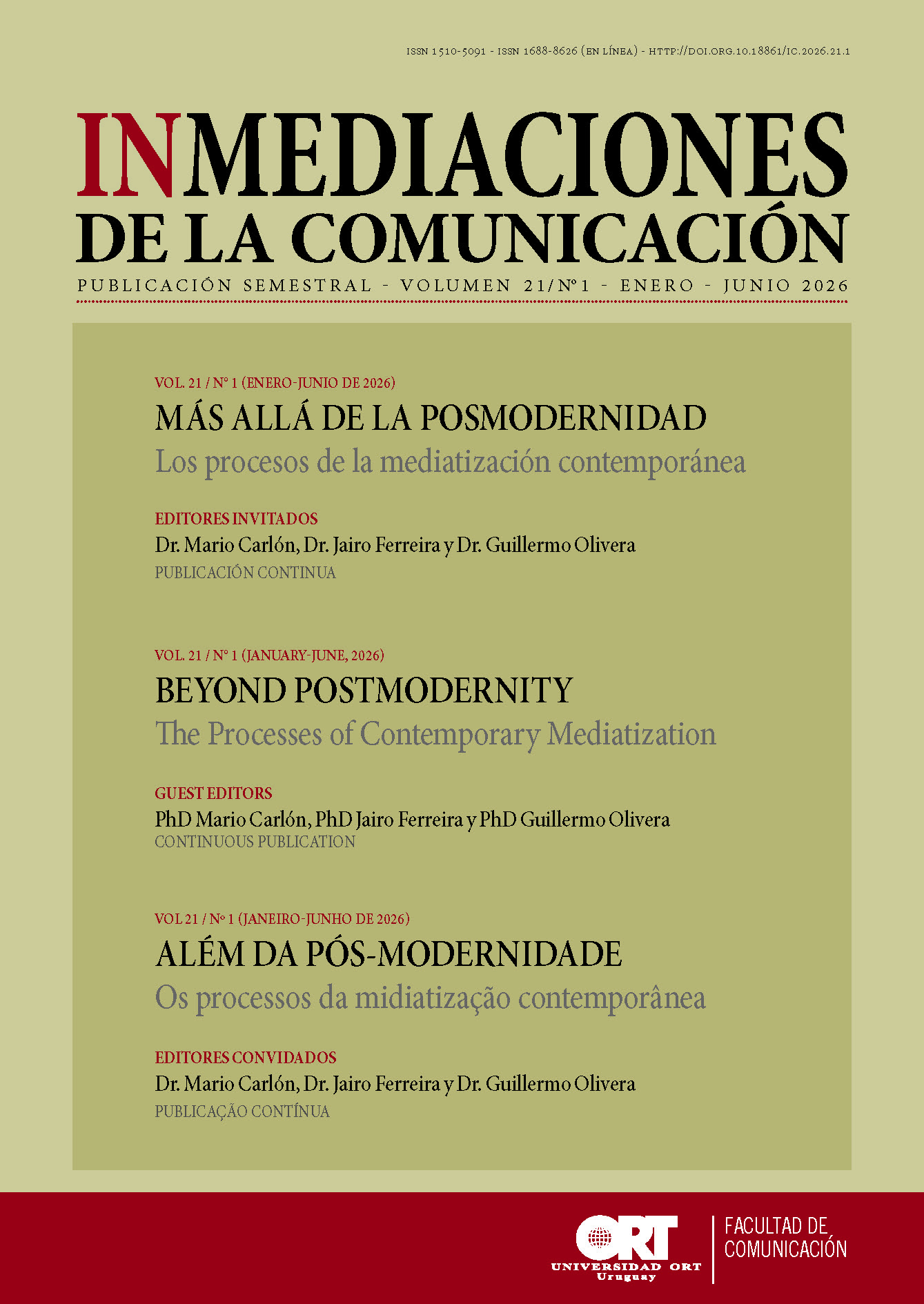
Interview with Friedrich Krotz
Mediatization as Metaprocess. A Historical-process Perspective
DOI:
https://doi.org/10.18861/ic.2026.21.1.4459Keywords:
interview, Friedrich Krotz, mediatizationAbstract
Friedrich Krotz is one of the most prominent figures in the field of mediatization studies in Northern Europe and a pioneer of such perspective in Germany, having first introduced this concept and approach to communication
science research in that country in 1995. After a long career at various German and Swiss universities, as well as a number of important research stays at various universities around the world, Krotz is currently Professor Emeritus of Communication and Media at the Universität Bremen (Germany). In conversation with InMediaciones de la Comunicación, he reflects on his academic career, his assumptions or epistemic starting points, his strongly historical perspective, the processual nature of his approach, and his key original contribution to the field: mediatization as a (historical) “metaprocess”, analogous to other “long-term transcultural metaprocesses” studied by the social sciences, such as globalization, individualization, modernization, literacy, and industrialization, to name a few.
Downloads
References
Babbage, C. (1832). On the Economy of Machinery and Manufactures. Charles Knight.
Beck, U. (1986). Risikogesellschaft. Suhrkamp.
Borges, J. L. (1974). Die Bibliothek von Babel. In Die Bibliothek von Babel (pp. 53-63). Reclam.
Cassirer, E. (2007). Versuch über den Menschen. Felix Meiner.
Grenz, T. & Pfadenhauer, M. (2016). Einleitung: De-Mediatisierung: Diskontinuitäten, Non- Linearitäten und Ambivalenzen im Mediatisierungsprozess. In Grenz, T. & Pfadenhauer, M. (Hrsg.), De-Mediatisierung: Diskontinuitäten, Non- Linearitäten und Ambivalenzen im Mediatisierungsprozess (pp. 3-23). Springer VS.
Illich, I. (1980). Selbstbegrenzung. “Tools for Conviviality”. Rowohlt.
Illich, I. (2010). Im Weinberg des Textes. Beck.
Krotz, F. (1995). Elektronisch mediatisierte Kommunikation. Rundfunk und Fernsehen, 43, 445-462.
Krotz, F. (2001). Die Mediatisierung kommunikativen Handelns. Westdeutscher Verlag.
Krotz, F. (2003). Metaprozesse sozialen und kulturellen Wandels und die Medien. Medien Journal, 27, 7-19.
Krotz, F. (2007). Mediatisierung. Fallstudien zum Wandel von Kommunikation. VS Verlag für Sozialwissenschaften.
Krotz, F. (2008). Handlungstheorien und Symbolischer Interaktionismus als Basis kommunikationswissenschaftlicher Forschung. In Winter, C., Hepp, A. & Krotz, F. (Hrsg.), Theorien der Kommunikations- und Medienwissenschaft (pp. 29-47). VS Verlag für Sozialwissenschaften.
Krotz, F. (2010): Zivilgesellschaft und Stiftung Medientest. In Schicha, C. & Brodsda, C. (Hrsg.), Handbuch Medienethik (pp. 244-254). VS Verlag für Sozialwissenschaften.
Krotz, F. (2011). Mediatisierung als Metaprozess. In Hagenah, J. & Meulemann, H. (Hrsg.), Mediatisierung der Gesellschaft? (pp. 19-41). Lit Verlag.
Krotz, F. (2017a). Explaining the mediatisation approach. Javnost–The Public, 24(2), 103-118.
Krotz, F. (2017b). Mediatisierung: Ein Forschungskonzept. In Krotz, F., Despotovic, C. & Kruse, M.-M. (Hrsg.), Mediatisierung als Metaprozess. Transformationen, Formen der Entwicklung und die Generierung von Neuem (pp.13-32). Springer VS.
Krotz, F. (2021). Das Mögliche als Kritik des Existierenden. Studies in Communication and Media, 10(2), 222-245.
Krotz, F. (2022). Die Teilung geistiger Arbeit per Computer: eine Kritik der digitalen Transformation. Beltz/Juventa.
Krotz, F. (2024). Digitalisation Today as the Capitalist Appropriation of People’s Mental Labour. Triple-C, 22(1). https://doi.org/10.31269/triplec.v22i1.1477.
Lasswell, H. D. (1948). The Structure and Function of Commuication in Society. In Bryon, L. (Hrsg.), The Communication of Ideas (pp. 37-51). Harper.
Martín-Barbero, J. (1993). Communication, Culture and Hegemony. From the Media to Mediations. Sage.
Mead, G. H. (1973). Geist, Identität und Gesellschaft. Suhrkamp.
Rojas, R. (2016). Der erste Programmierer der Welt. Telepolis, 31(1). https://www.telepolis.de/article/Der-erste-Programmierer-der-Welt-3377889.html?seite=all
Schütz, A. (2004). Der sinnhafte Aufbau der Sozialen Welt. UVK
Stein, P. (2010). Schriftkultur. Eine Geschichte des Schreibens und Lesens, 2. WBG.
Tegmark M. (2019). Leben 3.0. Mensch sein im Zeitalter künstlicher Intelligenz. Ullstein.
Turing, A. M. (2002). Kann eine Maschine denken? In Zimmerli, W. C. (Hrsg.), Künstliche Intelligenz. Philosophische Probleme (pp. 39-78). Reclam.
Weber, M. (1978). Soziologische Grundbegriffe, 4. Mohr Siebeck.