
Convergent didactic experiences on the configuration of architectural space and its materialisation in design practice
DOI:
https://doi.org/10.18861/ania.2026.16.1.3991Keywords:
project process, architectural space, technique, materiality, morphology, structure, creativity, pedagogical innovation, teaching, project-based didactics, project research, project experimentation, workshop-laboratoryAbstract
This article analyzes the incorporation of design-thinking structures that articulate form, matter, and structure in architectural design teaching. This approach is based on the systematization of two convergent didactic experiences developed within the Architecture programme at the National University of the Northeast: Architecture II – Pedagogical Unit “B” and Form and Matter: Stereotomy and Tectonics. Both courses approach architectural design as an integrative, experimental, and reflective process in which knowledge is constructed through action, within a flipped classroom framework.
Adopting an exploratory-analytical qualitative methodology, the study surveyed the pedagogical devices used, the design strategies implemented, and the learning evidenced in students’ productions. The analysis was organized around five conceptual axes: project-based didactics as a situated practice; project research and reflection-in-action; form-matter-structure project logics; stereotomic and tectonic formative design processes; theory and practice as a unity in heuristic thinking.
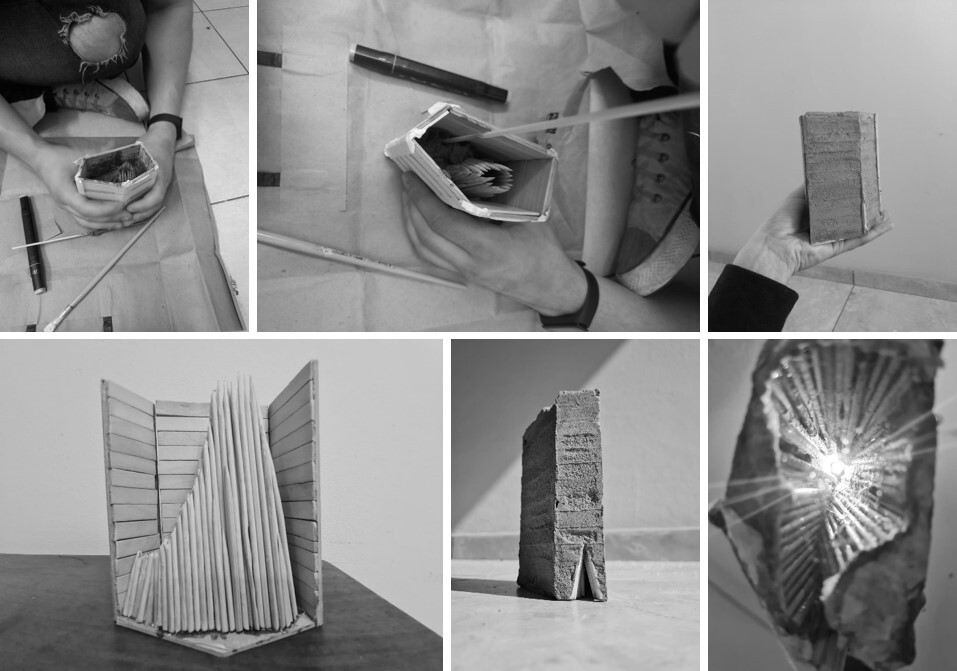
The results show that the design of open-ended tasks, the use of physical models, critical analysis of architectural works, and experimentation with mono-materials foster a deep understanding of architectural space as the outcome of integrated design operations. Students develop analytical, procedural, and communicative skills, consolidating a critical, autonomous, and collaborative attitude within the design process.
It is concluded that the explicit incorporation of projective conceptual frameworks not only enhances the quality of learning but also transforms pedagogical practices towards more integrative, sensitive and contextualized approaches. This study provides operational insights for rethinking the teaching of design as the active production of architectural knowledge.
Downloads
References
Baquero, Ricardo. (2002). Del experimento escolar a la experiencia educativa: La "transmisión" educativa desde una perspectiva psicológica situacional. Perfiles educativos, 24(97-98), 57-75.
Benyus, Janine M. (2012) Biomímesis. Cómo la ciencia innova inspirándose en la naturaleza. Barcelona (España): Tusquets Editores S.A.
Boutet, M. Laura (2010). Aplicación de una estrategia didáctica innovadora en el Taller de Arquitectura: Diseño Estructural Intuitivo. Indagación y análisis de un caso real. Revista Estudios en Ciencias Humanas. Facultad de Humanidades. UNNE.
Boutet, M. Laura; Virili, Juan C. (2018). La Relación “Clima – Hecho Arquitectónico – Tecnología”, Propuesta de Innovación Pedagógica Integral del Taller de Arquitectura II – U.P. “B” FAU – UNNE”, Libro de Ponencias (formato digital pdf) del X Congreso Regional de Tecnología en Arquitectura “Tecnología y Políticas Públicas”. Facultad de Arquitectura y Urbanismo de la Universidad Nacional de La Plata. Pp. 173 a 183. ISBN 978-950-34-1661-7.
https://congresocreta2018.files.wordpress.com/2018/09/libro-completo-x-creta_final.pdf.
Campo Baeza, A. (2008). De la cueva a la cabaña. De lo estereotómico y lo tectónico en la arquitectura. En: Pensar con las manos. Madrid: Mairea.
Catalano, E. (1996) La Constante. Diálogos sobre estructura y espacio en Arquitectura. Buenos Aires (Argentina) Cambridge Architectural Press, EE. UU. Editorial Universitaria de Bs. As. S.E.M..
Cravino, A. M. (2023). Enseñanza de la arquitectura: entre planes de estudios, talleres y docentes. Pensu, (2), 1-15.
https://revistas.unc.edu.ar/index.php/pensu/article/download/39240/39830?inline=1
Czajkowski, J. y Gómez, A. (2009). Arquitectura sustentable. Ed. Clarín. Buenos Aires, Argentina.
Dewey, J. (1916). Democracy and education: An introduction to the philosophy of education. New York: Macmillan.
Engel, H. (2006) Sistemas de Estructuras. Barcelona (España) Editorial Gili, SA.
Fiscarelli, D. M. y Bellot, R. (2023). La enseñanza de las asignaturas técnicas en arquitectura: El caso de las instalaciones, herencia academicista versus integración disciplinar. Anales de Investigación en Arquitectura, 13(1). DOI: https://doi.org/10.18861/ania.2023.13.1.3421
Litwin, E. (1997). El oficio de enseñar. Condiciones y contextos. Paidós.
Mahave, Alberto P.; Romano, Delia E.; Naón, Vanesa S. (2022). Enseñanza del proyecto y el diseño del espacio arquitectónico. Forma y Materia. Estereotomía-Tectónica. Comunicaciones Científicas y Tecnológicas Anuales 2022. Edición FAU – UNNE. ISSN 1666-4035.
Moisset, I. (2015). Enseñar / investigar arquitectura. Revista de Arquitectura de la Universidad de Lima. N.° 1, pp. 49- 65.
Moisset de Espanés, D. (2000) Intuición y Razonamiento en el Diseño Estructural. Editor INGRESO, Córdoba, Argentina, p. 12.
Olgyay, V. (1998) Arquitectura y Clima. Manual de Diseño Bioclimático para Arquitectos y Urbanistas. Editorial Gili. Barcelona, España.
Períes, Lucas (2020), Estereotomía y topología en arquitectura. Córdoba, EDUCC –Universidad Católica de Córdoba.
Piñón Helio. (2005). La forma y la mirada. Buenos Aires: Nobuko.
Rodríguez, L. G., Fiscarelli, D. M., & Fernández, J. L. (2022). La dimensión técnica en la enseñanza proyectual: entre la ciencia y el diseño. Arquitecto, (19), 53-62. DOI: 10.30972/arq.0195969
Schon, D. (1992). La formación de profesionales reflexivos. “Hacia un nuevo diseño de la enseñanza y el aprendizaje en las profesiones. España: Paidos. Pp. 17-51.
Tschumi, Bernard (2005), Concepto, contexto y contenido. Revista Internacional de Arquitectura y Diseño ARQUINE. Vol 34, Texto 2. México.
Ventura, Daniel (2010). La construcción tectónica del espacio. Maestría en Arquitectura, FADU-UNL.
Ventura, Daniel (2018, 14 de diciembre). La construcción tecnológica del espacio. Revista Notas CPAU, https://revistanotas.org/revistas/41/2286-la-construccion-tecnologica-del-espacio
Downloads
Published
How to Cite
Issue
Section
License
Copyright (c) 2026 Mgter. Arq. Alberto Patricio Mahave, Dra. Arq. María Laura Boutet

This work is licensed under a Creative Commons Attribution 4.0 International License.
The journal and its contents are licensed under the Creative Commons - Attribution 4.0 International License (CC BY 4.0). It is possible to copy, communicate and publicly distribute its content as long as the individual authors and the name of this publication are cited, as well as the publishing institution (Universidad ORT Uruguay).